

When an emergency happens, the hardest problem is often not knowing what the hazard is. It is knowing where everyone is, whether they are safe, what they should do next, and how the household will reconnect if normal communication stops working. A practical household emergency communication plan solves those questions before anyone is stressed, separated, driving, caring for a child, helping a neighbor, or trying to make decisions with a nearly dead phone.
This guide shows you how to build a communication plan that works for ordinary households, not just for disaster professionals. The goal is to create a small, repeatable system: who contacts whom, which methods you try first, where you meet, what information each person carries, how you handle children and pets, how you communicate when cellular service is unreliable, and how you test the plan without turning preparedness into a complicated project.
Federal preparedness guidance consistently emphasizes the same core ideas: choose meeting places, identify an out-of-area contact, keep important phone numbers somewhere other than only on a phone, use multiple communication methods, sign up for local alerts, and practice the plan. Ready.gov also recommends setting up group text lists and having alternative charging options available for phones during outages. The American Red Cross recommends choosing both a nearby meeting place and another location outside the neighborhood in case people cannot return home.
 Emergency communication planning is most useful when it is completed before a crisis. Image: FEMA/National Archives via Wikimedia Commons, public domain in the United States.
Start With the Real Problem: Your Household May Be Separated
A weak emergency plan assumes everyone will be home when something happens. Real life is usually messier. One adult may be at work, another may be driving, a child may be at school, a teenager may be at sports practice, an older relative may be at a medical appointment, and a pet may still be inside the home. A communication plan should begin with this assumption: the household may be scattered across several locations when the emergency starts.
Write down the places where household members normally spend time during a weekday and weekend. Include home, work, school, daycare, university, common relatives’ homes, places of worship, medical facilities, regular recreation locations, and any location where someone spends several hours. You do not need an elaborate map. You are trying to expose the points where separation is likely.
Then ask one practical question for each person: “If phone calls fail for two hours, what should this person do?” The answer should not be “keep calling everybody.” It should be a simple action such as staying at the school until an authorized pickup arrives, going to a designated meeting place if safe, sending one text to the household group, or contacting the out-of-area person.
This step matters because stress causes people to improvise. Improvisation is sometimes necessary, but it becomes dangerous when several people make conflicting decisions. One person drives home while another leaves home to look for them. A parent heads toward a school while the school has already moved students to an alternate reunification site. A teenager walks toward a familiar location while relatives are driving in another direction. Your communication plan reduces unnecessary movement by giving people default actions.
Choose One Out-of-Area Contact Everyone Knows
One of the most useful elements of a household communication plan is an out-of-area contact: a trusted person who lives outside the immediate community and is unlikely to be affected by the same local emergency. The American Red Cross recommends this approach because local phone infrastructure can be overloaded or disrupted while communication to a person outside the area may still be possible.
Choose someone who is reasonably organized, usually answers messages, and is comfortable receiving status updates from multiple people. They do not need emergency-management expertise. Their role is simple: act as an information hub when household members cannot reach each other directly.
For example, your plan might say:
- Everyone first sends a short message to the household group.
- If the group does not work, each person sends the same message to Aunt Maya, who lives in another state.
- Aunt Maya records who has checked in and passes information between household members.
- No one assumes silence means someone is in immediate danger; they follow the agreed next step and conserve battery.
Give the out-of-area contact the names, phone numbers, and basic roles of everyone in the household. Tell them about the meeting places and explain what information you want them to collect. A useful update format is: Name — location — safe/not safe — next action — next check-in time. This keeps messages short and reduces confusion.
Do not make the mistake of choosing an out-of-area contact without telling them. Ask first. Make sure they understand that they are not expected to coordinate rescue or give official safety advice. Their job is to help relay status information.
Create Two Meeting Places, Not One
The Red Cross recommends choosing two meeting locations: one close to home for a sudden event and another outside the neighborhood if the household cannot safely return. This is better than a single meeting place because different emergencies create different movement restrictions.
Meeting place 1: immediately outside the home
This location is for fast evacuations such as a fire, smoke alarm, gas odor, or another situation where everyone must leave the building quickly. Choose a specific fixed point that is easy to identify day or night: a particular neighbor’s driveway, a mailbox across the street, a lamp post, a tree, or another safe point away from the building and emergency vehicle access.
The purpose is accountability. Everyone exits, goes to that exact point, and stays there. Nobody goes back inside to look for another person. Emergency responders need accurate information about who is still unaccounted for, and a clear gathering point reduces the chance that someone appears “missing” simply because they walked to a different corner.
Meeting place 2: outside the neighborhood
This location is for a larger incident that blocks access to your street or neighborhood. Choose somewhere familiar, publicly identifiable, and likely to remain accessible: a relative’s home outside the immediate area, a library, community center, place of worship, or another location that your local emergency planning does not identify as a common hazard zone.
Do not choose a meeting place merely because it is memorable. Consider whether it may itself be vulnerable to flood, wildfire, industrial hazards, coastal evacuation, or road closure. If your region has specific evacuation zones, use local emergency-management maps to avoid choosing a location inside the same risk area.
Write the full address of both meeting places on each person’s emergency contact card. Children should know the name of the place, not only recognize it visually.
Add a Third Layer: A Conditional Destination
For households with more complex needs, add a third destination that is used only under a specific condition. Examples include a relative’s home farther away during regional evacuation, a pet-friendly lodging option, or a location accessible to a household member with mobility needs.
This is not the same as creating many competing meeting places. The rule must be conditional and easy to remember. For example: “If the city issues an evacuation order and we cannot reach Uncle Sam’s house, we go to the county-designated shelter shown in the official alert.” Keep the decision rule tied to a clear trigger rather than personal guessing.
Build a Communication Ladder Instead of Depending on One App
Emergency communication fails when a household depends on one tool. A group chat is useful until the mobile network is congested, the app requires data that is temporarily unavailable, someone’s phone battery dies, or one family member cannot access the account. A communication ladder defines the order in which you try different methods.
A simple household ladder might be:
- Read official emergency alerts and follow immediate safety instructions.
- Send a short group text message.
- If that fails, send individual SMS messages to the out-of-area contact.
- If data works but SMS does not, try the household’s agreed messaging app or email.
- If networks are unreliable, conserve battery and retry at agreed intervals rather than continuously.
- If digital communication is unavailable, follow the meeting-place and location rules already agreed in the plan.
Ready.gov preparedness materials specifically encourage households to create group text lists, keep emergency numbers outside the phone, and maintain alternative power sources for devices. Some Ready.gov family guidance also notes that text messages may succeed when voice calls are difficult during emergencies, and excessive calling can contribute to congestion. That does not mean text messages always work; it means SMS is an important option in a multi-method plan.
Make the ladder visible on the household plan. The main benefit is behavioral. Instead of every person repeatedly trying every possible method, everyone follows the same sequence.
Use a Short Check-In Message Format
During an emergency, long messages create problems. They take longer to type, may fail to send, encourage unnecessary back-and-forth, and can omit the information that actually matters. Standardize a short check-in format before the emergency.
A useful template is:
SAFE – Alex – North Library – staying here – next check 4:00 PM
Or:
NEED HELP – Dana – 114 Oak St parking lot – ankle injury – with neighbor Kim
Or:
EVACUATING – Chris + dog – leaving home for Meeting Place 2 – route B
The message should answer five questions: who, where, condition, next action, next check-in. Avoid vague messages such as “I’m okay I think” or “Where is everybody?” because they create more questions than answers.
Teach household members not to share sensitive medical details or precise live locations in public social-media posts unless there is a clear reason. Direct communication with trusted contacts is usually better for household coordination.
Put Critical Numbers on Paper
Phones are excellent storage devices until they are damaged, locked, lost, out of power, or inaccessible to someone helping you. Ready.gov recommends storing important phone numbers somewhere besides only your phone, and the Red Cross recommends carrying emergency contact information in writing.
Create one small card for each household member. It should include:
- Full name.
- Home address.
- Primary household phone numbers.
- Out-of-area contact name and phone number.
- Meeting place 1 and meeting place 2.
- School, daycare, or workplace contact when relevant.
- Critical medical or accessibility information only when appropriate and with privacy in mind.
- A short instruction such as “Text household group; if no response, contact Maya.”
Keep a copy in a wallet, backpack, school bag, emergency kit, and vehicle if appropriate. Review the cards whenever someone changes a phone number, workplace, school, caregiver, or regular travel pattern.
For young children, keep the card simple. They should know their own full name, the names of their caregivers, and what trusted adult or authority figure they should approach if separated. Do not overload a young child with a multi-step plan they cannot realistically execute.
Make the Plan Work for Children and Schools
Schools and childcare facilities usually have their own emergency procedures. Your household plan must work with those procedures, not override them. Find out how the school sends alerts, who is authorized to pick up a child, where reunification may occur if the campus is evacuated, and what identification adults need to present.
Add authorized backup pickup people before an emergency if the institution permits it. Choose people who are actually likely to be reachable and close enough to help. Inform the child, in age-appropriate language, that a trusted backup adult may collect them during an emergency.
Tell children the most important rule: they should follow school staff instructions and should not leave a supervised location merely because they cannot reach a parent by phone. A child trying to “get home” independently can turn a communication problem into a search problem.
For older children and teenagers, agree on the exact check-in message format. Make sure they know that a delayed reply from a parent does not automatically mean they should start traveling. They should follow the plan’s default action.
Account for Older Adults, Disabilities, and Access Needs
A communication plan is incomplete if it assumes everyone can hear an alarm, read a small phone screen, walk to a meeting place, drive, understand complex instructions under stress, or operate the same devices independently.
List specific support needs without reducing a person to a diagnosis. Ask practical questions. Does someone need mobility assistance? Do they depend on electrically powered medical equipment? Do they need information in large print or a different language? Is a caregiver normally present? Does a person rely on paratransit? Are medications time-sensitive? Is there a communication device that needs backup power?
Assign backup helpers, preferably more than one, because one person may be unavailable. Helpers should know what they are responsible for and what they are not. For example, a neighbor may agree to check that an older adult received an evacuation notice, but should not be expected to perform medical care.
Store necessary contact information on paper as well as digitally. If a person uses a medical-alert system, know whether it depends on cellular service, a landline, broadband, or power, and what the fallback is during an outage.
Include Pets Without Making the Plan More Complicated
Pets often cause households to delay evacuation because people do not know who is responsible for them or where they can go. Assign the role before the emergency. One person should normally be responsible for securing carriers, leashes, medications, and identification if conditions allow it safely.
Keep a current photo of each pet, ideally including the pet with an owner, and save copies securely. Ready.gov preparedness materials encourage current pet photos because they can help if animals and owners become separated.
Record the veterinarian, microchip information, a backup caregiver, and at least one evacuation option that accepts animals. Do not assume every emergency shelter or hotel will accept pets under every circumstance. Local policies differ, so verify your local arrangements periodically.
Most important, nobody should re-enter a dangerous building to retrieve a pet. Tell emergency responders that an animal may still be inside.
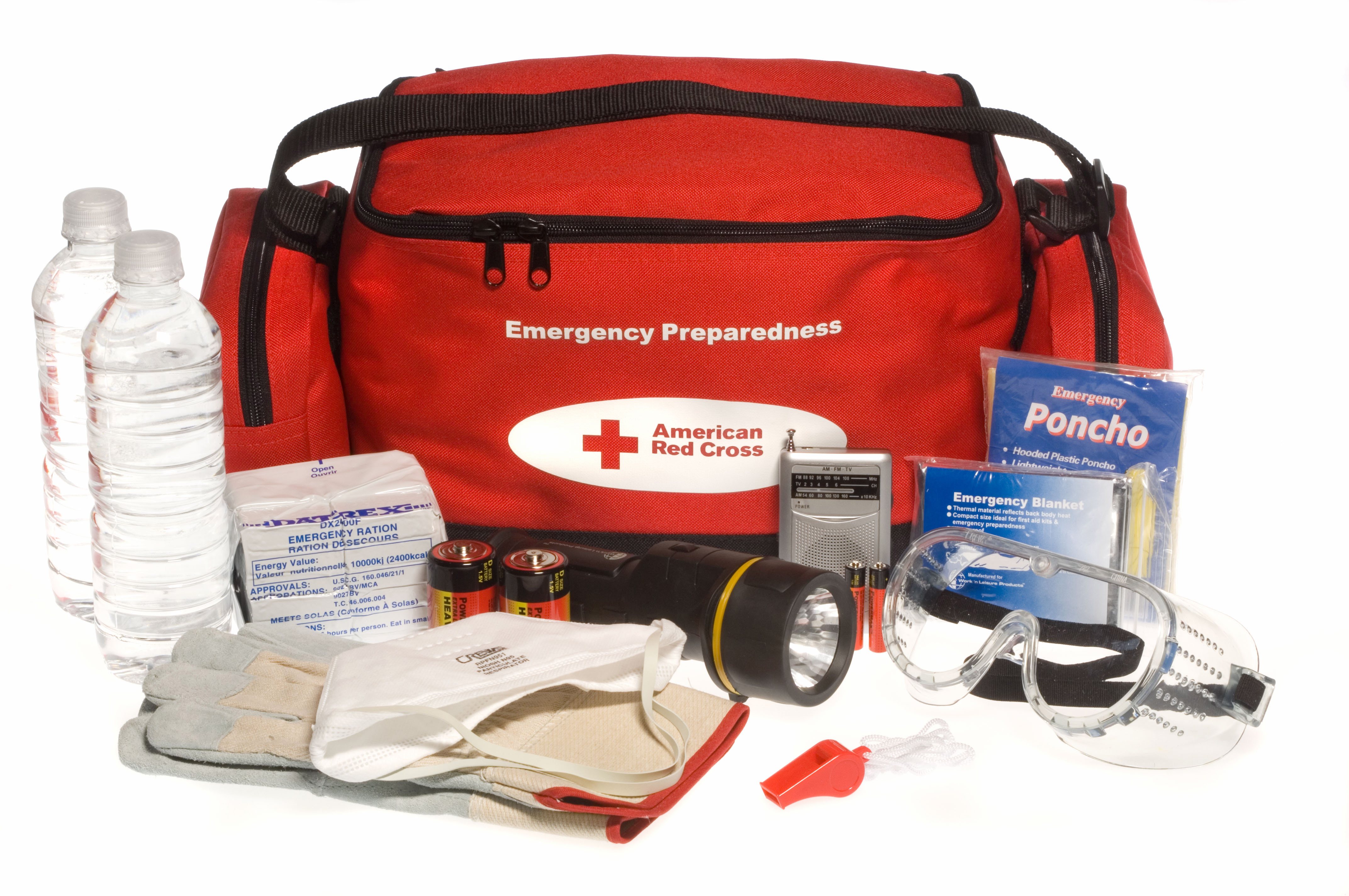 A communication plan works best when it is coordinated with the household’s emergency supplies and power options. Image: FEMA Photo Library via Wikimedia Commons, public domain in the United States.
Set Up Emergency Alerts Before You Need Them
Your household communication plan should not depend on relatives being the first source of hazard information. Sign up for official alerts from your local emergency-management agency if available, and make sure compatible phones can receive Wireless Emergency Alerts where supported. Ready.gov also points households to the FEMA app for weather and emergency alerts in the United States.
Everyone should know the difference between an official instruction and a message from a friend. During fast-moving emergencies, rumors can spread faster than verified information. Use local authorities, emergency-management agencies, weather services, transportation agencies, and other official sources for instructions about evacuation, sheltering, road closures, and all-clear notices.
Do not disable emergency alerts simply because some are inconvenient. Instead, review the alert settings available on each device and understand which categories can be adjusted. Exact controls vary by operating system, carrier, and country.
If you live outside the United States, use the equivalent national and local alert services in your country. The planning principle is the same even when the technology or warning terminology differs.
Create a Battery Strategy for Phones
A communication plan collapses if every phone reaches 2 percent battery during a long outage. Ready.gov recommends alternative charging methods, and this is one of the easiest parts of the plan to improve.
Keep at least one charged power bank that can recharge the household’s primary phones. Larger households may need several. Store the correct cables with the battery rather than assuming someone will find a cable in the dark. Recharge power banks on a recurring schedule, because a battery stored for months may not remain full.
Teach battery conservation:
- Lower screen brightness.
- Use low-power mode when appropriate.
- Stop nonessential video streaming and large downloads.
- Turn off unnecessary wireless functions if they are not being used.
- Send concise messages rather than maintaining long calls.
- Take screenshots of important information if you may lose data access.
- Use agreed check-in times instead of refreshing messages every minute.
If you use a vehicle to recharge devices, follow vehicle and carbon-monoxide safety guidance. Never run a fuel-burning vehicle in an enclosed garage or other unsafe space. Portable generators also require strict outdoor placement and safety precautions; do not treat them as a simple phone charger.
Decide How Often to Check In
Continuous communication wastes battery and creates anxiety when networks are delayed. Your plan should include check-in intervals for a prolonged event.
For example, after the initial safety message, household members might attempt another update every 30 or 60 minutes unless circumstances change. The exact interval is less important than having an agreed rhythm. If someone has already reported “safe at school, staying in supervised shelter,” repeated calls every two minutes do not improve safety.
Add one rule: send a new message immediately if your location, condition, or planned destination changes. That is more useful than frequent “still okay” messages with no new information.
Know When Not to Travel to a Meeting Place
A meeting place is not an instruction to ignore official warnings. If authorities tell people to shelter in place, if roads are unsafe, or if the path crosses a hazardous area, staying where you are may be safer than trying to reunite immediately.
Your written rule should say something like: “Meeting places are used only when travel is safe and consistent with official instructions.” This prevents the plan from becoming rigid in the wrong way.
Similarly, do not ask household members to drive through flooded roads, wildfire evacuation zones, active emergency scenes, severe weather, or other hazards merely because the family “agreed to meet.” A communication plan coordinates safe decisions; it does not replace hazard-specific safety guidance.
Create a Simple Role Chart
Assign responsibilities by role, not personality. The plan might designate:
- Primary communicator: starts the household group check-in when safe.
- Child pickup lead: follows school reunification procedures.
- Backup pickup: acts only if the primary cannot.
- Pet lead: secures pets and carriers when safe.
- Equipment lead: takes the emergency bag, medications, and charger if evacuation time allows.
- Out-of-area contact: receives and relays status updates.
Every role needs a backup. Emergencies often occur when the person who normally handles a task is away. Avoid roles that require someone to endanger themselves. “Go back inside for documents” is not an acceptable role.
Make a One-Page Version and a Detailed Version
Long plans are useful for preparation but terrible for quick reference. Maintain two versions.
The one-page plan
This should contain the household contacts, out-of-area contact, two meeting places, basic communication ladder, key responsibilities, and check-in message format. Print it and place copies in practical locations.
The detailed plan
This version can include school procedures, caregiver information, pet arrangements, medical-equipment notes, evacuation routes, insurance contacts, local emergency numbers, and links to official alert sources. Store it securely because it may contain private information.
The one-page version should be understandable in under two minutes. If it requires a training session every time someone reads it, simplify it.
Protect the Plan From Becoming a Privacy Problem
Emergency plans naturally contain sensitive data: names, addresses, phone numbers, schedules, medical needs, schools, and travel destinations. Do not publish the plan publicly or leave detailed copies in places where strangers can easily photograph them.
The wallet card should include only what that person may need in an emergency. The detailed version can be stored securely at home and in an encrypted digital location accessible to appropriate household members. If you share a copy with an out-of-area contact, tell them that it contains private information and should not be forwarded casually.
Balance privacy with usefulness. A plan encrypted with a password nobody remembers is not useful. A plan posted publicly is too exposed. Choose a method that household members can realistically access under stress.
Prepare for Network Congestion
One of the most common communication mistakes during a major incident is assuming that “no reply” means the recipient has not seen the message or is in danger. Networks can queue messages, calls may fail, and data can be intermittent.
If voice calls fail, try a concise text according to your communication ladder. If the message does not immediately show as delivered, avoid sending 20 identical copies. Move to the next agreed method or wait for the planned retry interval. Repeated retries can consume battery and make the household’s message history harder to interpret.
If internet data remains available, an agreed messaging app or email may work. If only Wi-Fi is available at a safe location, use it if you trust the network and can do so securely. Do not delay evacuation or remain in an unsafe building just because it has working Wi-Fi.
Plan for a Completely Dead Phone
Ask each household member what they would do if their phone disappeared at the start of the emergency. This thought experiment immediately exposes weak plans.
A workable answer might be: follow workplace or school procedures, go to the designated safe meeting place when permitted, use the written contact card, ask a trusted authority figure to call the out-of-area contact, and wait rather than wandering.
Adults should memorize at least one important phone number in addition to emergency services. Many people have stopped memorizing phone numbers because contacts are stored automatically. Knowing the out-of-area contact’s number can be extremely useful if you must borrow a phone.
Coordinate the Plan With Evacuation Routes
Communication and evacuation planning should reinforce each other. Write down a primary and alternate route to the outside-neighborhood meeting location, but do not assume those routes will always be open.
Store offline maps or paper maps if your area is unfamiliar or vulnerable to network outages. The Red Cross advises plotting alternate routes and having maps available on devices and on paper. If authorities issue a specific evacuation route, follow that direction rather than your preferred shortcut.
For households without a car, identify the local public-transportation, paratransit, neighbor-assistance, or emergency-evacuation options that may apply. These vary widely by community, so check local emergency-management resources rather than relying on generic advice.
Use a Status Board at Home
A simple whiteboard or printed sheet near the exit can help when household members leave at different times. During a developing situation, one person can write: “Alex at school, Dana at office, Chris took dog, meeting at library if evacuation ordered.” This is not a substitute for digital messages, but it can reduce confusion if someone returns home briefly.
Keep the board generic enough that it does not expose routine schedules to people outside the household. During ordinary days, do not display a detailed “everyone is away until 8 PM” schedule in a window-facing location.
Practice the Plan Without Creating Panic
A plan that has never been practiced is only a document. Practice does not need to be dramatic. The Red Cross recommends practicing elements of household emergency plans and evacuation routes.
Run a 15-minute tabletop exercise. Pick a scenario such as: “There is a neighborhood evacuation at 2:30 PM. One adult is at work, one child is at school, mobile calls are unreliable, and the usual route home is closed.” Ask each person what they would do.
Do not coach immediately. Listen first. You will often discover contradictions: two people believe they are supposed to pick up the same child, nobody remembers the out-of-area contact, the meeting place name is too vague, or a teenager assumes they should walk home even though the plan says stay at school.
After the exercise, change the written plan. A drill is successful when it exposes a flaw; you do not need everyone to perform perfectly on the first attempt.
Run a Real Communication Test
Once or twice a year, test the actual communication ladder under normal conditions. Send a mock message to the household group. Ask everyone to reply using the standard format. Then simulate failure of the group chat and have everyone contact the out-of-area person.
Verify that the contact has current numbers. Check that school and workplace information is still correct. Test the power banks. Confirm that printed cards are still in wallets and bags.
This is also the time to check whether children have moved schools, someone changed jobs, an older adult’s caregiver changed, a pet’s veterinarian changed, or a family member now uses a different phone number.
 Preparedness improves when people review and practice their plan instead of storing it unread. Image: U.S. Army Corps of Engineers Savannah District via Wikimedia Commons, public domain in the United States.
How to Handle Common Failure Scenarios
Nobody can reach the out-of-area contact
Use a backup contact. Your plan should list a second person who can serve the same function. If both are unreachable, household members continue following the agreed local actions and check-in intervals. The out-of-area contact is helpful, not a single point of failure.
The meeting place is inaccessible
Do not improvise ten new destinations by text. Use the predefined secondary destination or follow official shelter and evacuation guidance. Send a concise change message when possible.
One household member did not check in
First consider their expected location and procedures. A child at school may not have access to a phone. An employee may be in a controlled shelter area. Follow the institution’s official communication channel. Avoid sending multiple household members independently to search the same area.
Only one person has a working phone
That person becomes the communication hub but should conserve power. Write down messages if several people are sharing the device. Use scheduled check-in windows rather than continuous use.
The power outage lasts all day
Switch to battery conservation early rather than waiting until phones are nearly dead. Use power banks strategically and keep one reserve if practical. If you already have a household blackout plan, coordinate charging priorities with it.
Social media contains conflicting information
Use official emergency sources for protective actions. Treat neighborhood posts as observations, not authoritative instructions. Verify road closures, evacuation orders, shelter locations, and all-clear messages through official channels whenever possible.
A Worked Example: Four-Person Household
Consider a household with two adults, a 15-year-old, a 9-year-old, and one dog. On weekdays, Adult A works 12 miles from home. Adult B works from home three days a week and commutes on two. The teenager attends a high school three miles away. The younger child attends an elementary school one mile away.
They choose Adult A’s sister, who lives 200 miles away, as the out-of-area contact. Everyone has her phone number on a printed card. Meeting Place 1 is the large oak tree across from the home. Meeting Place 2 is the public library five miles away and outside their immediate flood zone. A relative’s house 20 miles inland is the conditional evacuation destination for regional storms if authorities direct evacuation.
The communication ladder is: official alerts first, household group SMS second, individual message to the sister third, agreed messaging app fourth, email fifth. If nothing works, each person follows their location-specific rule. Children remain with school staff until authorized pickup. Adults do not leave safe locations merely because a text has not arrived.
The teenager’s standard message is: “SAFE – Jamie – high school – staying with staff – next check 4:00.” The adults use the same format. The younger child does not carry a phone, so the parents rely on the school’s alert and reunification system.
Adult B is the primary pet lead if at home. Adult A is backup. Both know where the carrier, leash, food, records, and medication are stored. Nobody goes back into an unsafe home for the dog.
Every six months they test the group message, call the out-of-area contact, update the cards, and check power-bank charge. Once a year they run a tabletop scenario. The plan is not long, but every member knows the defaults.
Build Your Plan in 30 Minutes
If you have delayed preparedness because it feels like a major project, use this compact workflow.
- Minutes 1–5: Write the names, phone numbers, schools, workplaces, and common daytime locations of household members.
- Minutes 6–10: Choose the out-of-area contact and one backup.
- Minutes 11–15: Choose the near-home meeting point and outside-neighborhood meeting location.
- Minutes 16–20: Write the communication ladder and standard check-in format.
- Minutes 21–25: Assign child, pet, medication, and emergency-bag responsibilities with backups.
- Minutes 26–30: Print or write contact cards and schedule a short practice date.
Do not wait for the plan to become perfect. A simple tested plan is more useful than a sophisticated document nobody remembers.
What Success Looks Like
A good emergency communication plan passes several tests. Any adult can explain it without reading a full binder. Children know the parts appropriate for their age. Everyone knows the two meeting places. At least one important contact number exists on paper. The out-of-area contact has agreed to the role. Household members know which official alerts they receive. Nobody is dependent on a single app. Power banks are charged. Responsibilities have backups. The plan is practiced and updated.
Most importantly, the plan answers the question “What do I do next?” even when another household member cannot immediately respond.
Common Mistakes to Avoid
- Keeping every phone number only in one smartphone. Paper backup matters.
- Choosing a meeting place without checking local hazards. A familiar location can still be unsafe.
- Making voice calls the only communication method. Use a ladder with texts and other options.
- Assuming children can leave school when they cannot reach a parent. Coordinate with school procedures.
- Creating roles with no backups. The primary person may be absent.
- Ignoring privacy. Share detailed personal information only with people who need it.
- Never practicing. Untested plans contain hidden contradictions.
- Traveling despite official instructions to shelter. Safety instructions override reunion convenience.
- Forgetting battery management. A phone with no power cannot execute a digital plan.
- Using vague messages. Include location, condition, next action, and next check-in time.
Frequently Asked Questions
Should everyone call the same person during an emergency?
It can be useful for everyone to know one out-of-area contact who acts as an information hub, especially during a local disruption. However, the plan should also have a backup contact and should not depend entirely on reaching one person.
Is texting always better than calling?
No method is guaranteed. Preparedness guidance often recommends text messaging as an option when voice networks are congested, but SMS, mobile data, Wi-Fi, and voice calls can all fail in different ways. The strongest plan uses multiple methods in a clear order.
How often should we update the plan?
Review it at least periodically and immediately after meaningful changes such as new phone numbers, schools, jobs, caregivers, medical needs, pets, addresses, or evacuation arrangements. A twice-yearly check is easy to remember for many households.
What if we live in an apartment?
The communication principles are the same, but include building-specific evacuation routes, management contacts, stairway procedures, assembly locations, and accessibility arrangements. Do not rely on elevators during situations where building guidance says they should not be used.
Should the plan include medical information?
Include only information that is genuinely useful and appropriate for the person carrying the plan. Sensitive medical details should be protected. For people with critical medications, allergies, communication needs, or medical devices, a carefully designed emergency information card can be valuable.
Do I need special technology?
No. The core system can be created with paper, ordinary phones, SMS, and agreed meeting places. Apps, cloud storage, location sharing, satellite features, and other technologies can improve resilience, but they should be additions rather than the only way the plan works.
Your First Action Today
Do one thing before you close this page: choose your out-of-area contact and ask whether they are willing to serve as the household’s relay person. Then write their number on paper. That single action creates the first backup outside your phone and turns preparedness from an idea into a working system.
The most damaging mistake is not having an imperfect plan; it is having no shared default at all. When everyone knows how to check in, where to meet, when to stay put, and who can relay information, the household can make calmer decisions even when normal communication is disrupted.