

Quick answer: If your home receives water from a U.S. public water system, start with the annual Consumer Confidence Report (CCR), sometimes called an annual water quality report. Find the section that lists detected contaminants, then compare the reported result with the applicable regulatory value. Do not confuse an MCLG, which is a non-enforceable public-health goal, with an MCL, which is an enforceable maximum contaminant level. Some contaminants are regulated through treatment techniques, action levels, or disinfectant limits rather than a simple MCL. Check whether the utility reported any violation, what the likely source was, what period the data cover, and whether the number is an average, range, percentile, or individual sample. For concerns such as lead at your own tap, a community-wide report may not tell you the concentration in your specific home, so targeted testing can be appropriate. If you use a private well, public-water CCR rules do not apply; CDC recommends regular well testing through a state-certified laboratory and guidance from your local health or environmental department.
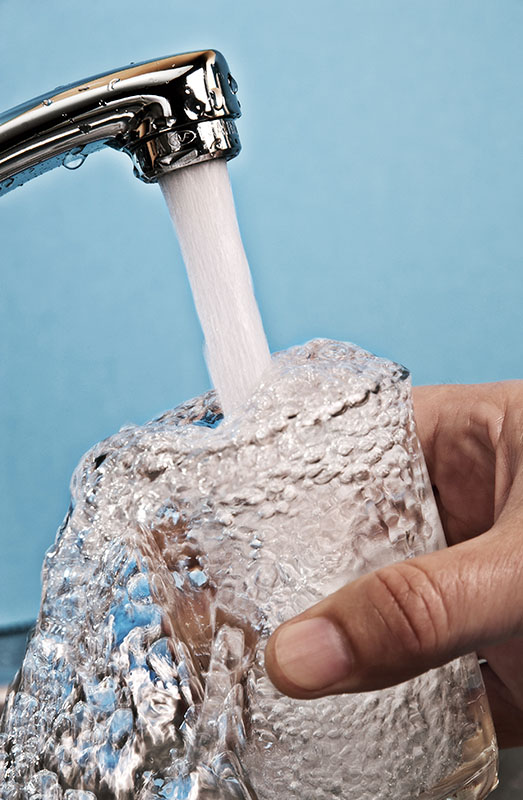 A clear appearance does not prove that water is free of every regulated contaminant; laboratory testing and utility monitoring provide information that sight, smell, and taste cannot. Image: Klaus Ohlenschläger, Wikimedia Commons, CC BY-SA 3.0.
Water-quality reports can look more complicated than they really are. A typical report may contain tables filled with abbreviations such as MCL, MCLG, AL, TT, MRDL, ppb, ppm, and pCi/L. Some rows show a single number; others show a range or a percentage. A contaminant can be “detected” without representing a violation. Another substance may not have a conventional maximum concentration at all because the rule is based on a treatment technique or an action level.
The most useful skill is not memorizing dozens of federal limits. It is learning how to read the report as a decision document. You need to identify your water source, understand the regulatory vocabulary, compare the right numbers, notice the date and sampling method, distinguish system-wide monitoring from your own household plumbing, and know when the report answers your question—and when it does not.
This guide focuses mainly on the U.S. public-water system because EPA’s Consumer Confidence Report requirements and federal drinking-water standards are specific to the United States. If you live elsewhere, the same reading method is still useful, but use your country’s regulator and local utility limits. It also includes a separate workflow for private wells, where household owners are responsible for testing and maintenance.
1. First Identify Whether You Use Public Water or a Private Well
This is the most important first branch because it determines what information should exist.
If you pay a municipal utility, water district, apartment management company, or another provider that obtains water from a regulated public water system, you will normally have access to a Consumer Confidence Report. EPA requires community water systems to provide customers with annual information about drinking-water quality.
If your property uses a privately owned household well, the federal Safe Drinking Water Act protections that apply to public systems do not apply in the same way. CDC states that private wells are not routinely regulated, treated, or monitored by public officials under those federal public-water rules. The owner is responsible for making sure the water is safe.
Practical check: Look at your water bill, property records, or utility account. If the bill names a water utility, search for that exact provider plus “Consumer Confidence Report” or “annual water quality report.” If there is a well head, well pump, pressure tank, or property documentation showing a private well, use the private-well section of this guide.
2. Find the Correct Consumer Confidence Report
Do not assume the first PDF you find is current or belongs to your service area.
EPA maintains a Consumer Confidence Report portal and a tool for finding reports. Utilities also publish reports on their own websites. Confirm:
- the utility name;
- the service area or system name;
- the year of the report;
- the period covered by the monitoring data;
- whether your property actually receives water from that system.
Large utilities may serve several zones or obtain water from multiple sources. Apartment buildings can also have internal plumbing conditions that differ from the distribution system. The report is therefore your starting point, not a guarantee that every faucet has identical water chemistry.
3. Know What a CCR Is Designed to Tell You
A Consumer Confidence Report is meant to summarize the drinking water supplied by a community system. It typically includes information about:
- where the water comes from;
- regulated contaminants that were detected;
- the applicable regulatory standard or treatment requirement;
- whether there were violations;
- possible sources of detected contaminants;
- health or compliance information required by the rule;
- contact information for the water system;
- special notices or educational statements when required.
EPA revised the CCR rule in 2024 to improve readability and accessibility, with major revised requirements beginning in 2027. EPA’s current CCR page, updated in June 2026, remains the best place to understand the federal reporting framework.
4. Do Not Panic When You See the Word “Detected”
A detected contaminant is not automatically a violation.
Modern laboratory methods can measure substances at extremely low concentrations. A utility may report a detectable amount that remains below an enforceable standard. The correct question is:
What was detected, what regulatory framework applies, and how does the reported result compare with that framework?
Likewise, “not detected” does not mean that the substance literally cannot exist in the water. It generally means the laboratory did not detect it at or above the method’s reporting or detection level used for the analysis.
5. Learn the Difference Between MCLG and MCL
These two abbreviations appear together frequently and are easy to confuse.
MCLG — Maximum Contaminant Level Goal: EPA defines this as a non-enforceable public-health goal. It is the level below which there is no known or expected risk to health, with a margin of safety. MCLGs are based on health considerations and do not necessarily reflect the practical limits of detection or treatment.
MCL — Maximum Contaminant Level: This is an enforceable standard. EPA sets MCLs as close to the MCLG as feasible while considering available treatment technology and other statutory factors.
Therefore, if a table shows an MCLG of 0 and an MCL above 0, that is not a contradiction. It means the health goal and the enforceable regulatory level serve different purposes.
6. Understand Treatment Techniques
Some contaminants are not regulated through a simple maximum concentration. EPA may instead require a Treatment Technique (TT).
A treatment technique is an enforceable procedure or performance requirement that a public water system must follow to control a contaminant. This approach is used when measuring the contaminant at the necessary level is not the most practical or reliable way to protect health.
If your report lists “TT” rather than a numerical MCL, do not try to compare the result to a number that does not exist. Read the compliance explanation for that rule.
7. Understand Action Levels
An Action Level (AL) is different from a conventional MCL. EPA’s CCR guidance defines an action level as a contaminant concentration that, when exceeded under the rule’s sampling framework, triggers treatment or other requirements for the water system.
Lead and copper are familiar examples because exposure can arise from corrosion of service lines and premise plumbing rather than only from the water leaving the treatment plant.
This matters because a community’s lead result is not simply “the average amount of lead in everyone’s tap.” Sampling rules are designed around selected sites and regulatory metrics.
8. Understand Disinfectant Limits
Water systems often add disinfectants to control disease-causing microorganisms. Reports can therefore include:
- MRDLG: Maximum Residual Disinfectant Level Goal;
- MRDL: Maximum Residual Disinfectant Level.
The MRDL is the highest level of a disinfectant allowed under the rule. EPA’s definition also recognizes that disinfectant use provides an important benefit by controlling microbial contaminants.
A reader should therefore avoid the simplistic conclusion that “any chlorine is contamination.” Disinfection has a public-health purpose, and the regulatory framework balances residual disinfectant levels with microbial control.
9. Decode the Units Before Comparing Numbers
Never compare two numbers until you confirm their units.
| Unit | Common meaning | Approximate relationship |
|---|---|---|
| mg/L | milligrams per liter | often equivalent to ppm in water |
| µg/L | micrograms per liter | often equivalent to ppb |
| ng/L | nanograms per liter | often equivalent to ppt |
| pCi/L | picocuries per liter | unit of radioactivity |
A result of 4 ppb is one thousand times smaller than 4 ppm. A PFAS result reported in ppt cannot be compared directly with another value in ppb unless you convert the units correctly.
Common mistake: Copying a number into a search engine without its unit and assuming the first limit you find is comparable.
10. Read the Entire Contaminant Row From Left to Right
Instead of focusing on the largest number, read every column.
A typical row may include:
- contaminant name;
- date sampled;
- result or detected level;
- range of detections;
- MCL or regulatory requirement;
- MCLG or health goal;
- whether there was a violation;
- likely source.
Some utilities also provide system-specific notes. A result may be a running annual average rather than a single sample. Another may show the highest sample. Another may report a percentile or number of sites above a threshold.
Read the column heading and footnote before interpreting the number.
11. Pay Attention to the Sampling Date
Annual reports can legally include monitoring from different years because not every regulated contaminant is sampled at the same frequency.
If you see an older date, that does not automatically mean the utility forgot to test. Monitoring schedules can vary by contaminant and compliance history.
However, the date matters when you are asking a current household question. If the report’s arsenic result comes from an earlier compliance period but you are responding to a new local incident, contact the utility or regulator for more recent information rather than treating the annual report as real-time monitoring.
12. Understand “Range” Versus “Average”
A utility may sample multiple treatment plants, wells, distribution locations, or dates. The report may therefore show both an average and a range.
Example:
Average: 1.8 ppb
Range: 0.4–3.2 ppb
The average tells you the central compliance value; the range shows variability among samples. Which number determines compliance depends on the specific drinking-water rule.
Do not assume that the maximum end of a range automatically represents your tap.
13. Distinguish Acute From Long-Term Concerns
Some drinking-water contaminants are primarily associated with short-term risks at high exposure, while others are regulated because of health effects associated with long-term exposure.
The CCR may provide required health-effects language when standards are exceeded. Use that language and EPA’s contaminant pages rather than interpreting toxicology from the chemical name alone.
If the utility issues a boil-water notice, do-not-drink notice, or other emergency advisory, follow the current advisory. An annual report is not a substitute for emergency instructions.
14. Understand Why Turbidity Is Different
Turbidity describes cloudiness caused by suspended particles. In regulated surface-water systems, turbidity is closely tied to treatment performance and filtration rather than functioning only as an aesthetic measurement.
A CCR may therefore report turbidity using treatment-technique compliance metrics instead of one simple MCL number.
Visible cloudiness at your faucet can also have household causes, including air bubbles or plumbing disturbance. If cloudiness does not clear, appears suddenly, or is accompanied by an advisory, contact the utility.
15. Read Nitrate Results Carefully
Nitrate is important because high concentrations can pose particular risk to infants. In public systems, the CCR will show the regulated result and standard.
For private wells, CDC specifically recommends annual nitrate testing because wells can be affected by fertilizers, septic systems, animal waste, runoff, and local geology.
If an infant will consume formula prepared with well water, or if a household has a new pregnancy, CDC recommends reviewing well testing with local health officials rather than assuming that clear, good-tasting water is safe.
16. Understand Arsenic as a Source-Water Problem
Arsenic can occur naturally in rock and groundwater in some regions. It can therefore appear even where there is no obvious nearby industrial source.
A public system monitors arsenic under federal and state requirements. Private-well owners may need targeted testing based on local geology and health-department recommendations.
Do not assume that boiling water removes arsenic. Boiling is a microbial emergency technique under certain advisories; it is not a universal chemical-removal process and can concentrate some dissolved substances as water evaporates.
17. Read Lead Information Differently From Most Source-Water Contaminants
Lead is unusually important because the water leaving the treatment plant may contain little or no lead, yet lead can enter water through service lines, solder, brass fixtures, older plumbing components, or corrosive water conditions.
That means the system-wide CCR cannot tell you with certainty what your individual kitchen faucet contains.
If your home has a known or suspected lead service line, old plumbing, recent plumbing disturbance, or another reason for concern, use utility or local health guidance for tap sampling. Testing is the only way to determine the concentration at the sampled tap under the specific sampling protocol.
18. Do Not Use Hot Tap Water for Drinking or Cooking When Lead Is a Concern
EPA advises using cold tap water for drinking and cooking when reducing lead exposure, because hot water can dissolve lead more quickly from plumbing materials.
If you need hot water, start with cold water and heat it separately.
A filter can also be useful when it is specifically certified for lead reduction, but the certification claim matters more than the fact that the product is called a “water filter.”
19. Choose Lead Filters by Certification Claim
EPA’s current consumer filter tool recommends point-of-use filters evaluated by accredited third-party certification bodies for lead reduction. EPA specifically points consumers to products certified under relevant NSF/ANSI standards and warns that filters must be installed and replaced according to the manufacturer’s instructions.
Do not buy a pitcher simply because its packaging says “clean water.” Look for the exact contaminant-reduction claim and verify it in a certification body’s product directory when possible.
An expired cartridge may no longer provide the claimed reduction.
20. Understand the Current PFAS Situation in 2026
PFAS regulation is unusually important to verify because federal requirements are changing.
EPA’s current PFAS drinking-water page states that the 2024 final rule established enforceable MCLs for six PFAS-related regulatory measures, including 4.0 parts per trillion for PFOA and PFOS. However, on May 18, 2026, EPA proposed changes: it proposed maintaining the PFOA and PFOS MCLs while allowing some systems additional time, potentially until 2031, to comply, and separately proposed rescinding certain regulatory provisions covering PFHxS, PFNA, HFPO-DA, and a PFAS Hazard Index. The public-comment period on the PFOA/PFOS compliance-extension proposal closed July 20, 2026.
Practical implication: Do not rely on an old blog post or a screenshot of a 2024 chart to understand current PFAS compliance obligations. Use EPA’s live PFAS drinking-water pages and your state regulator.
21. Know Why PFAS Numbers Look Extremely Small
PFAS results are often reported in parts per trillion, or nanograms per liter. That can make a table look strange if other contaminants are reported in parts per million.
For example, 4 ppt is not “almost the same” as 4 ppb. It is one thousand times smaller.
Always compare like units and use the specific PFAS compound named in the report. “PFAS” is a broad class, not one chemical.
 Public water systems monitor and treat water under regulatory requirements before distribution, but some household-specific issues—especially those involving premise plumbing—may require separate investigation. Image: Alisa Huckaby, Wikimedia Commons, CC BY-SA 4.0.
22. If PFAS Are Reported, Ask What Was Actually Measured
Before buying treatment equipment, identify:
- which PFAS compounds were tested;
- the result and unit;
- whether the result is system-wide monitoring or a specific location;
- the regulatory status as of the current date;
- whether the state has a stricter or additional requirement;
- what action the utility is taking.
EPA notes that public systems are expanding PFAS monitoring and reporting under the federal framework. Your utility may also publish more recent monitoring data than the annual CCR.
23. Choose PFAS Filters by a Verified Reduction Claim
EPA’s filter guidance identifies certified point-of-use options such as activated carbon and reverse-osmosis systems for certain PFAS reduction claims. It recommends checking product labels and accredited certification directories for PFAS reduction under standards such as NSF/ANSI 53 or 58.
But certification claims have scope. A device certified for PFOA/PFOS reduction is not automatically certified for every PFAS compound.
Maintenance matters too. Replace cartridges on schedule, operate the system within its specified flow and water-quality conditions, and do not assume a neglected filter continues to provide certified performance indefinitely.
24. Understand Disinfection Byproducts
Disinfectants are essential for controlling microbes, but they can react with naturally occurring material in source water and form disinfection byproducts.
These substances have their own regulatory framework. CCRs may list total trihalomethanes or haloacetic acids with results based on regulatory averaging procedures.
The correct interpretation is not “disinfection is bad.” The utility must control both microbial hazards and regulated byproducts. If the report shows a violation, read the required explanation and utility response.
25. Do Not Confuse Hardness With a Federal Health Violation
Hard water typically contains higher levels of calcium and magnesium. It can create scale, affect soap performance, and leave mineral deposits, but hardness itself is not the same thing as an exceedance of a federal primary drinking-water MCL.
A water softener can address hardness but is not a universal drinking-water purifier. It does not automatically remove lead, PFAS, nitrate, arsenic, microbes, or every other contaminant.
Choose treatment based on measured water chemistry and the device’s verified claim.
26. Understand Secondary Standards
EPA also has secondary drinking-water standards for certain aesthetic or technical characteristics such as taste, odor, color, staining, or scaling. These are different from the primary standards that address health protection.
A report may discuss substances that affect appearance or taste without indicating a health-based violation.
This distinction explains why water can be compliant but still have noticeable mineral taste or staining.
27. Color, Taste, and Odor Are Clues—not Laboratory Tests
A sudden change in water appearance, smell, or taste deserves attention, but sensory clues cannot prove that water is chemically safe.
Some serious contaminants have no obvious taste, odor, or color. Conversely, harmless air bubbles can make tap water appear cloudy for a short time.
If your water changes suddenly, contact the utility. Private-well owners should consider testing, especially after flooding, repairs, or changes in local conditions.
28. Know What a Boil-Water Advisory Can and Cannot Do
A boil-water advisory is usually issued because of possible microbial contamination or loss of system integrity. Follow the exact instructions from the utility or health authority.
Boiling is not a general-purpose solution for chemical contamination. If officials issue a “do not drink” or “do not use” notice because of a chemical incident, boiling may be ineffective or inappropriate.
The type of advisory matters more than the phrase “water problem.”
29. Use Current Public Notices During Emergencies
The annual CCR is historical. During a main break, contamination incident, flood, loss of pressure, wildfire, industrial spill, or treatment failure, look for current notices from:
- your water utility;
- local health department;
- state drinking-water regulator;
- emergency-management agency.
Do not wait for the next annual report.
30. Understand Why Your Neighbor’s Water Test May Differ
Two homes on the same street can have different lead, copper, iron, or microbial results because of:
- different service-line materials;
- different internal plumbing;
- different fixture materials;
- different water-use patterns;
- different stagnation times;
- different sample collection procedures.
A neighbor’s result is useful context, not a substitute for testing your tap when a household-specific concern exists.
31. Know When Home Testing Kits Are Not Enough
Consumer test strips can be useful for basic screening of characteristics such as hardness or disinfectant residual, but a serious health question should use an appropriate laboratory method.
For private wells, CDC recommends using a state-certified laboratory. For public-water household concerns, your utility or health department can direct you to certified labs and proper sampling methods.
Sampling protocol matters. A lead sample collected after five minutes of flushing answers a different question from a first-draw sample collected after a defined stagnation period.
32. Use the Right Container and Sampling Procedure
Do not rinse laboratory-preserved bottles or transfer a sample into a household jar unless the lab tells you to.
Different analyses may require:
- sterile containers;
- chemical preservatives;
- specific sample volumes;
- cold storage;
- short holding times;
- first-draw conditions;
- flushed samples.
Follow the certified laboratory’s kit instructions exactly. A perfectly accurate instrument cannot rescue a badly collected sample.
33. Private-Well Owners Need a Separate Routine
If you have a private well, do not wait for a CCR because your household well usually does not produce one.
CDC recommends testing at least once each year for:
- total coliform bacteria;
- nitrate;
- total dissolved solids;
- pH.
CDC also advises asking the local health or environmental department what additional contaminants matter in your area, such as arsenic, lead, volatile organic compounds, pesticides, mercury, radium, or other locally relevant chemicals.
34. Test a Private Well After Events That Can Change Water Quality
CDC recommends additional testing when:
- flooding affects the area;
- the well is repaired;
- land disturbance occurs nearby;
- a waste-disposal problem occurs;
- water color, taste, or smell changes;
- a pregnant person joins the household;
- a child begins living in the home;
- officials identify a local groundwater concern.
Floodwater is particularly important because it can carry sewage, chemicals, and other contaminants into vulnerable wells.
35. Do Not Treat Well Water Before You Know the Problem
A treatment system should be selected for a measured contaminant.
CDC emphasizes that no single home treatment type removes every germ or chemical. Filtration, disinfection, distillation, ion exchange, activated carbon, and reverse osmosis solve different problems.
If a test shows harmful contamination, contact the health department or a qualified well professional before choosing equipment. Then retest after treatment to verify that the system works.
36. Read a Laboratory Report With the Same Discipline as a CCR
A private laboratory result may include:
- analyte;
- result;
- unit;
- reporting limit;
- method;
- sample date;
- sample location;
- reference or regulatory level.
Do not interpret “<0.005” as zero unless the lab says that. It usually means the result was below a reporting threshold.
If the lab flags a result, ask what standard the flag uses and whether it applies to your water source and jurisdiction.
37. Understand pH as a Water-Chemistry Clue
pH tells you whether water is relatively acidic or basic. It can affect corrosion, taste, treatment, and plumbing behavior.
CDC notes that very low or high pH in private well water can damage plumbing, and corrosive conditions can contribute to metals such as lead entering water from plumbing materials.
Do not treat pH as a complete safety score. A normal pH does not prove that bacteria, nitrate, arsenic, or PFAS are absent.
38. Understand Total Dissolved Solids
Total dissolved solids, or TDS, measures the combined concentration of dissolved material. It can influence taste and scaling.
A handheld TDS meter does not identify which substances are present. A reading of 300 ppm cannot tell you whether the dissolved material is mostly calcium, sodium, nitrate, or something else.
Use contaminant-specific testing when health questions exist.
39. A High TDS Reading Does Not Prove Water Is Dangerous
This misconception is common in water-filter marketing.
Mineral-rich water can have a higher TDS value without exceeding a primary health standard. Conversely, water with a low TDS value can still contain a low-concentration contaminant that matters for health.
Judge water by the specific contaminant and applicable standard, not a single conductivity-derived number.
40. Avoid “Zero TDS = Perfect Water” Claims
Extremely low TDS simply means fewer dissolved ions are being measured. It is not a universal measure of microbiological safety, organic contaminants, or every regulated chemical.
Use TDS as one water-quality parameter, not a purity score.
41. Understand the Difference Between Point-of-Use and Point-of-Entry Treatment
Point-of-use (POU) treatment serves one drinking-water location, such as a kitchen faucet or pitcher.
Point-of-entry (POE) treatment treats water as it enters the house.
A POU filter can be appropriate when the goal is reducing a contaminant in water used for drinking and cooking. Whole-house treatment may be appropriate for contaminants or characteristics that affect bathing, plumbing, appliances, or every fixture.
The best configuration depends on the contaminant and household need.
42. Do Not Buy a Whole-House Filter Because of a Generic Sales Pitch
Ask the seller for:
- the exact contaminant-reduction claim;
- the certification standard;
- the accredited certification body;
- the certified flow rate;
- replacement schedule;
- performance data sheet;
- wastewater or regeneration requirements;
- maintenance cost;
- effect on water pressure.
If the salesperson cannot explain what the device is certified to remove, pause the purchase.
43. Verify Filters in Certification Directories
EPA’s current consumer guidance for lead and PFAS points users toward accredited third-party certification bodies. The certification mark on packaging is useful, but the product directory is better because it lets you confirm the exact model and claim.
Model numbers matter. A brand may sell several products with different certifications.
44. Follow the Cartridge Replacement Schedule
Filters have finite capacity. Performance can decline as media become exhausted or clogged.
Do not rely on taste as the replacement indicator. Many contaminants are not detectable by taste or smell.
Write the installation date on the cartridge or calendar, and follow the manufacturer’s gallons/time limit and any water-quality conditions.
45. Understand That Reverse Osmosis Also Needs Maintenance
Reverse-osmosis systems can reduce a wide range of dissolved contaminants when properly designed and certified, but they are not maintenance-free.
They typically include prefilters, membranes, postfilters, and a storage tank. Performance can change with feed-water pressure, temperature, chemistry, and maintenance.
If you rely on RO for a specific contaminant, use the certified claim and service schedule rather than assuming that any functioning membrane removes everything indefinitely.
46. Compare Bottled Water Claims Carefully
Bottled water can be useful during official advisories or when health officials recommend an alternate source, but “bottled” does not automatically mean “free of every contaminant.”
Use official emergency instructions during an incident. For routine household decisions, compare the actual water concern, treatment options, cost, waste, and certification rather than relying on branding alone.
47. If a CCR Shows a Violation, Read the Required Notice
Do not stop at the word “violation.” Determine:
- which rule was violated;
- when it occurred;
- whether the problem is ongoing;
- what health information applies;
- what corrective action the system took;
- whether consumers need to do anything now.
A monitoring/reporting violation is different from a measured contaminant exceedance, although both matter. The notice should explain the nature of the issue.
48. Call the Utility With Specific Questions
Instead of asking “Is my water safe?” ask questions that can be answered precisely:
- What sample dates produced this result?
- Is this value an average, range, or individual sample?
- Does this result apply to my pressure zone or source?
- Was there a violation?
- Are newer results available?
- Does the system know whether my service line contains lead?
- Is there a current advisory?
- Where can I obtain tap-testing instructions?
Specific questions produce better information.
49. Contact the State Drinking-Water Regulator When Needed
States generally have primary enforcement responsibility for public drinking-water systems once approved by EPA. State agencies can provide compliance records, enforcement information, certified laboratory lists, and local requirements that may be stricter than federal standards.
If utility information is unclear or you need regulatory confirmation, the state drinking-water program is an appropriate next step.
50. Use the Health Department for Household Risk Questions
If your concern involves an infant, pregnancy, immunocompromised household member, private well, local contamination event, or unusual test result, the health department can help translate the environmental result into practical public-health guidance.
This guide is educational and should not replace individualized medical advice. If a healthcare professional recommends testing because of a specific exposure or symptom, follow that clinical advice.
 When water quality is in doubt, use current utility or health-department information and contaminant-specific testing rather than judging safety from appearance alone. Image: Mateusz Konieczny, Wikimedia Commons, CC0 1.0.
51. Worked Example: A CCR Shows Arsenic Below the MCL
A homeowner sees:
Arsenic detected: 4 ppb
MCL: 10 ppb
MCLG: 0
The homeowner is confused because the MCLG is zero.
Correct interpretation: The MCLG is a non-enforceable health goal. The enforceable federal MCL is 10 ppb. A reported value of 4 ppb is below the federal MCL, assuming the table’s units and compliance calculation are correctly understood.
The homeowner may still choose to learn more about arsenic and personal exposure, but should not label the utility “in violation” based only on the MCLG.
52. Worked Example: A Lead Concern in an Older House
A family reads the city’s CCR and sees that the system complied with the lead rule. Their 1940s home may have old plumbing.
Correct interpretation: System compliance does not prove that the family’s specific kitchen tap has zero lead. Household plumbing can contribute lead after treated water enters the property.
Action: Ask the utility whether the service-line material is known, request approved sampling instructions, and use a certified laboratory or utility testing program. If filtration is used, select a product independently certified for lead reduction and maintain it correctly.
53. Worked Example: PFAS Appears in a 2026 Report
A CCR or utility data page reports PFOA at 2.2 ppt and PFOS at 1.4 ppt.
Correct first step: Confirm the sampling date, whether the values are individual results or compliance averages, and the current federal and state regulatory framework. As of August 2026, EPA’s PFOA and PFOS federal MCLs remain 4.0 ppt, while implementation timing is subject to a 2026 proposed extension rule.
Optional household action: If the household wants additional exposure reduction, check EPA’s current certified-filter guidance and verify the exact filter model’s PFAS claim. Do not assume any carbon pitcher removes PFAS.
54. Worked Example: Private Well After Flooding
A rural property experiences floodwater around the well head. The water looks clear after the flood recedes.
Incorrect response: Resume drinking it because the color and smell seem normal.
Better response: CDC advises that wells can become contaminated after flooding. Use a safe alternative water source while following local health-department guidance, inspect the well, disinfect or repair when directed, and test using a certified laboratory before returning to normal use.
55. Worked Example: High TDS but No Specific Contaminant Exceedance
A homeowner uses a handheld meter and reads 450 ppm TDS. A salesperson says the water is “unsafe.”
Correct interpretation: TDS alone does not identify the dissolved substances or prove a health-standard violation.
Next step: Read the CCR and, if there is a specific concern, test for that contaminant. If the problem is scale or taste, treatment may still be worthwhile, but it should be selected for the actual water characteristic.
56. Troubleshooting: “My Report Has No Result for the Chemical I Am Worried About”
Possible reasons include:
- the substance is not federally regulated;
- it was not detected and the report format does not list it;
- monitoring is reported elsewhere;
- the utility tested it under an unregulated contaminant program;
- the concern is specific to household plumbing;
- the report predates newer monitoring.
Contact the utility and state regulator. Ask specifically whether the substance was tested, when, where, and under what program.
57. Troubleshooting: “The CCR Is a Year Old”
Annual reports necessarily summarize prior monitoring. For routine understanding, that is normal. For a current incident, ask for newer data or current notices.
If your utility posts a live water-quality dashboard, recent PFAS monitoring, or current lead-service-line information, use that in addition to the CCR.
58. Troubleshooting: “My Water Smells Like Chlorine”
A chlorine odor does not by itself prove that the MRDL has been exceeded. Disinfectant residuals are intentionally maintained in many systems to control microbial growth.
If the odor is suddenly much stronger, contact the utility to ask whether treatment conditions changed. If you have a specific health concern, use official guidance rather than attempting to remove all disinfectant without understanding microbial risk.
59. Troubleshooting: “Brown Water Appeared After Utility Work”
Distribution-system work can disturb iron-containing sediment and discolor water. Follow utility flushing instructions when provided.
If discoloration persists, there is a current advisory, or the water has unusual odor or particles, contact the utility. Do not assume every brown-water event is harmless simply because infrastructure work occurred nearby.
60. Troubleshooting: “My Filter Changes the TDS Very Little”
Many carbon filters are designed to reduce specific organic chemicals, chlorine taste/odor, lead, or other claims without removing most dissolved mineral ions. TDS may therefore remain similar.
A filter can be working as certified even when the TDS meter barely changes. Verify performance using the contaminant claim, not a generic TDS reading.
61. Troubleshooting: “My Reverse-Osmosis System Has Very Low TDS—Is Everything Safe?”
Low TDS indicates substantial reduction of dissolved ions, but it is not proof of complete system sanitation or removal of every possible contaminant.
Maintain prefilters, membrane, storage tank, and postfilter. If the system is relied upon for a specific contaminant, verify that it is certified for that contaminant and consider periodic testing when appropriate.
62. A 20-Minute CCR Review Workflow
- Minutes 0–3: Confirm utility, report year, and water source.
- Minutes 3–6: Read definitions for MCL, MCLG, AL, TT, MRDL, and units.
- Minutes 6–12: Review the detected-contaminant table and highlight violations, values near limits, and household-relevant substances.
- Minutes 12–15: Read footnotes, sampling dates, ranges, and likely sources.
- Minutes 15–18: Read special notices on lead, PFAS, source water, or violations.
- Minutes 18–20: Write down questions for the utility or health department.
63. A Home Drinking-Water Decision Checklist
- I know whether I use public water or a private well.
- I have the correct current CCR for my public water system.
- I checked the year and sampling dates.
- I understand the difference between MCLG and MCL.
- I checked whether any row reports a violation.
- I read the footnotes and units before comparing numbers.
- I did not interpret “detected” as automatically unsafe.
- I understand that lead can be household-specific.
- I checked current EPA information for PFAS rather than relying on an old article.
- I verify water-filter claims through accredited certification directories.
- I replace filter cartridges on schedule.
- I do not use TDS as a universal safety score.
- If I use a private well, I test it at least annually for the core parameters CDC recommends.
- I use a state-certified laboratory for important well-water tests.
- I retest after treatment when officials recommend doing so.
- I follow current emergency advisories instead of relying on the annual report.
- I contact the utility or health department when results are unclear.
Frequently Asked Questions
Is water safe if every contaminant is below the MCL?
Meeting applicable drinking-water standards means the public system is complying with those regulated requirements, but it does not mean every possible substance is literally absent. Some contaminants are unregulated, some issues can arise in household plumbing, and private wells require separate testing. Use the report in the context of your specific concern.
Why does an MCLG sometimes say zero?
An MCLG is a non-enforceable health goal. EPA can set an MCLG at zero when the public-health goal is to avoid exposure, while the enforceable MCL reflects what can be reliably measured and controlled under the statutory framework.
What does “ND” mean?
It generally means “not detected” at or above the laboratory’s applicable detection or reporting threshold. It does not necessarily mean an absolute concentration of zero.
What is the difference between ppm, ppb, and ppt?
They represent progressively smaller concentrations. In water, ppm is commonly comparable to mg/L, ppb to µg/L, and ppt to ng/L. One ppm is 1,000 ppb; one ppb is 1,000 ppt.
Does my city’s lead result tell me the lead level in my house?
Not necessarily. Lead can enter water from service lines and household plumbing. If your home has lead-related risk factors, use an approved tap-sampling protocol and a certified laboratory or utility testing program.
Can boiling remove lead or PFAS?
No. Boiling is not a treatment for dissolved lead or PFAS. It is used under certain microbial advisories. For chemical contamination, follow utility and health-department instructions and use treatment certified for the specific contaminant when appropriate.
Does every water filter remove lead?
No. Look for a verified lead-reduction certification claim for the exact model. EPA provides a consumer tool for identifying certified point-of-use filters.
Does every reverse-osmosis system remove PFAS?
No automatic claim should be assumed. EPA recommends looking for a certified PFAS reduction claim under the relevant standard and verifying the model in an accredited certification directory.
How often should a private well be tested?
CDC recommends at least annual testing for total coliform bacteria, nitrate, total dissolved solids, and pH, plus additional contaminants recommended for your area. Testing is also advised after flooding, well repairs, significant changes in water quality, and certain household changes.
Who should I call if I do not understand my report?
Start with the water utility. For regulatory questions, contact your state drinking-water program. For private wells or health-risk questions, contact your local or state health/environmental department. Use a state-certified laboratory when testing is needed.
Conclusion: Read the Report as a System, Not a Scorecard
A drinking-water report is most useful when you stop looking for one magic “safe” number and instead read the system behind the numbers.
First identify your source. Public-water customers should use the current Consumer Confidence Report and understand the difference between health goals, enforceable limits, treatment techniques, action levels, disinfectant limits, units, ranges, and sampling dates. Private-well owners need their own testing program because federal public-system monitoring does not protect an individual household well.
Pay special attention to contaminants whose interpretation depends on location or changing regulation. Lead can be introduced by your service line or plumbing, so system-wide compliance may not answer a household-specific question. PFAS standards and implementation are actively evolving in 2026, so current EPA and state information matters.
The biggest mistake to avoid is buying treatment before identifying the problem. Test or verify first, then select a device certified for the exact reduction claim you need and maintain it correctly.
Your first practical step is simple: find your current CCR—or, if you use a private well, find your latest certified laboratory report. Circle the date, unit, detected result, and regulatory comparison for each item you care about. If any of those four pieces is missing or unclear, that is the question to ask your utility, regulator, health department, or laboratory.
Sources and Further Reading
- U.S. EPA — Consumer Confidence Reports
- U.S. EPA — Consumer Confidence Report Rule Revisions
- U.S. EPA — National Primary Drinking Water Regulations
- U.S. EPA — How EPA Regulates Drinking Water Contaminants
- U.S. EPA — PFAS Drinking Water Regulation
- U.S. EPA — Identifying Filters Certified to Reduce PFAS
- U.S. EPA — Filters Certified to Reduce Lead
- CDC — Guidelines for Testing Well Water
- CDC — Guidelines for Treating Well Water
- CDC — Groundwater Corrosivity and Lead in Wells
Image Credits
- “Trinkwasser-Wasserhahn.jpg” — Klaus Ohlenschläger, Wikimedia Commons, CC BY-SA 3.0.
- “Drinking Water Treatment Building.jpg” — Alisa Huckaby, Wikimedia Commons, CC BY-SA 4.0.
- “Water flowing from drinking water tap.jpg” — Mateusz Konieczny, Wikimedia Commons, CC0 1.0.