

Reading a scientific paper is not the same task as reading a textbook chapter, a news story, or a blog post. A research article is a compressed record of a question, a method, a set of observations, and an argument about what those observations mean. It is written mainly for people who already know the field, which is why a beginner can understand every individual word in a sentence and still have no idea what the sentence is doing.
The good news is that scientific papers become much easier when you stop treating them as documents that must be read from the first word to the last. Experienced readers usually work in passes. They first decide whether a paper is relevant, then identify the research question, inspect the evidence, study the methods needed to judge that evidence, and finally compare the authors’ interpretation with their own. That strategic approach is consistent with guidance from academic libraries and research-training resources, which emphasize active rather than purely linear reading.
This guide is designed for students, curious non-specialists, early-career researchers, writers, analysts, and anyone who needs to understand a scientific article without pretending to be an expert. You will learn how to screen a paper quickly, map its structure, read figures and tables, identify the study design, judge whether the conclusions match the results, recognize common statistical traps, check conflicts and limitations, use AI tools carefully, take durable notes, and decide what the paper actually changes in your understanding.
 Academic reading becomes easier when you approach a paper with a question and a plan rather than reading every line at the same speed. Image: Ktkvtsh, Wikimedia Commons, CC BY-SA 4.0.
Start with the right goal: know why you are reading the paper
Before opening the PDF, write one sentence that explains why you are reading it. This small step changes the entire process. A student preparing for an exam, a researcher planning an experiment, a journalist checking a claim, and a professional comparing two methods do not need the same level of detail from the same article.
Your goal determines what deserves attention. If you are deciding whether the paper belongs in a literature review, you may need only the question, study type, population, main result, and relevance. If you are reproducing the experiment, the methods and supplementary files may matter more than the introduction. If you are evaluating a health headline, you may care most about the design, sample, effect size, uncertainty, and whether the study can support a causal claim. If you are learning a new field, the references and definitions may be as important as the findings.
Write a reading question such as: “Does this study provide convincing evidence that X affects Y?” or “What method did the authors use to measure Z, and could I use it?” A vague goal such as “understand the paper” is too broad. A specific question gives you permission to ignore sections that do not help yet and return to them only if needed.
How to check that this step worked: you should be able to explain what information you hope to extract in one or two sentences. If you cannot, spend five minutes reviewing the title, abstract, keywords, and the context in which you found the paper.
Common mistake: opening a paper simply because it appeared near the top of a search result. Search ranking is not a quality score, and relevance to your question must be established before you invest time.
Understand what kind of paper you are looking at
Do not evaluate every scientific document as if it were the same kind of evidence. The words “study,” “paper,” and “research article” are used loosely online, but different article types answer different questions.
An original research article reports data collected or analyzed by the authors. It usually contains a methods section and a results section. A systematic review uses a defined search and selection process to synthesize multiple studies. A meta-analysis statistically combines compatible results from several studies. A narrative review summarizes a field but may not use a reproducible search process. A case report describes one or a few unusual cases and is useful for generating questions, not estimating how common an effect is. A protocol describes a planned study before results exist. A preprint is a manuscript shared before formal journal peer review. An editorial, perspective, or commentary is mainly argument or interpretation rather than new primary evidence.
The paper type tells you what claims are reasonable. A case report can show that something happened, but not how likely it is. A randomized trial can estimate the effect of an intervention under its conditions, but may not prove the same effect in every population. A cross-sectional survey can identify an association at one point in time, but often cannot establish which factor came first. A systematic review can be powerful, but only if its search, inclusion criteria, and component studies are sound.
Practical check: look near the title, abstract, methods, journal category, or database record for explicit labels such as “randomized controlled trial,” “cohort study,” “systematic review,” or “case-control study.” If the paper does not label itself clearly, infer the design from what the researchers actually did.
Use the first pass to decide whether the paper deserves a second pass
Your first pass should be fast. The goal is not comprehension; it is triage. Read the title, publication date, journal, author affiliations, abstract, section headings, figures, tables, conclusion paragraph, disclosures, and references. Do not stop to understand every unfamiliar term.
Ask five questions. First, what is the central research question? Second, what did the authors actually study: people, animals, cells, simulations, documents, images, or existing datasets? Third, what kind of design did they use? Fourth, what is the main result? Fifth, is this result relevant to your purpose?
This first pass may take five to fifteen minutes for a typical article. That is enough to reject many papers that initially looked useful. A title may promise your topic but the study population may be irrelevant. An abstract may describe a relationship that is statistically significant but too small to matter for your question. A review may be old relative to a fast-moving field. A paper about a model may not include real-world validation.
What success looks like: after the first pass, you should be able to write a three-line summary containing the question, design, and headline finding. If you cannot do that, the paper may be unusually complex, or you may lack background knowledge. In the second case, pause and find a recent review, textbook section, or reputable explainer before pushing deeper.
Alternative when time is limited: if you only need to decide whether to save the article for later, stop after this pass and record a one-sentence reason for keeping or discarding it.
Read the abstract twice—but for different reasons
The abstract is useful, but it is also dangerous because it compresses the entire study into a few sentences chosen by the authors. On the first pass, use it as a map. On the final pass, return to it as a test: does the full paper justify the impression the abstract creates?
Break the abstract into four elements: background, method, result, conclusion. The background tells you why the study was done. The method tells you the study type and usually the sample. The result should contain the most important numerical or qualitative finding. The conclusion tells you how the authors interpret that finding.
Do not let the conclusion sentence substitute for the results. If an abstract says an intervention “improved outcomes,” ask: improved by how much, compared with what, over what period, and with what uncertainty? If it says two variables were “associated,” check whether the article later speaks as if one caused the other. If it reports “no significant difference,” determine whether the study had enough precision to rule out an important difference.
Common mistake: quoting the abstract as if it were independent evidence. It is a summary of the same study, not a separate confirmation. Another common mistake is reading only the abstract and then confidently repeating the authors’ conclusion without seeing the methods, figures, limitations, or subgroup analyses.
Map the paper before reading it deeply
Most empirical scientific papers follow a recognizable structure even when journals rename or rearrange sections. The Introduction explains the problem and the gap. The Methods explain what was done. The Results report what was observed. The Discussion interprets those observations. Figures and tables often carry the densest evidence. References show how the work connects to previous literature. Supplementary files may contain crucial details that did not fit in the main article.
Make a quick map on paper or in your notes. Write the section names in a column and next to each one add a question: “Why was this study needed?” beside Introduction; “Exactly what did they do?” beside Methods; “What did they observe?” beside Results; “What do they think it means?” beside Discussion.
This prevents a common reading failure: confusing observations with interpretations. A result such as “Group A had a mean value 12 units higher than Group B” is an observation. A sentence such as “This suggests the intervention improves performance” is an interpretation. The distinction matters because the same data can sometimes support several interpretations.
When a paper has an unfamiliar structure, do not force it into a template. Qualitative research, mathematical papers, humanities-influenced science, machine-learning benchmarks, and some theoretical work may organize evidence differently. The useful question is always the same: where do the authors explain the problem, method, evidence, and inference?
Identify the research question before the authors’ answer influences you
After the first pass, state the main research question in your own words without looking at the conclusion. Good research questions usually include a population or system, an exposure or intervention, a comparison, and an outcome, although not every field uses this structure.
For example, instead of writing “The paper is about sleep and memory,” write: “Among university students, is shorter sleep duration associated with lower performance on a specific memory task after controlling for selected confounders?” The second version is far more useful because it exposes what the study can and cannot answer.
Then identify the authors’ hypothesis if there is one. A hypothesis is not just the topic; it is a testable prediction. Some exploratory studies deliberately do not begin with a strong directional hypothesis. That is acceptable, but exploratory findings generally deserve more cautious interpretation and often need confirmation in independent data.
Why this matters: once you know the exact question, you can judge whether the method actually answers it. Many weak interpretations come from a mismatch between the question people think a study asked and the question its design could answer.
Check your understanding: imagine explaining the research question to someone who has not read the paper. If your explanation includes the outcome, comparison, and studied population or system, you are probably close.
Read the figures before reading the authors’ full interpretation
Figures and tables are often the fastest route to the evidence. Scientific-reading guides frequently recommend examining them early because they show what was measured and how the central claims are supported.
For every figure, first read the title and legend. Identify what is on each axis, the units, the groups, sample sizes, error bars, symbols, colors, and statistical annotations. Then say out loud or write one sentence describing what the figure shows without using the authors’ interpretive language.
Next ask whether the visual design could exaggerate or hide differences. Does the y-axis begin far above zero, making a small difference look dramatic? Is the scale logarithmic? Are points shown individually or only as averages? Are outliers visible? Does a line imply continuity between measurements that were actually separate categories? Are several outcomes plotted while only one gets emphasized in the text?
Tables deserve the same care. Look for absolute numbers, denominators, missing values, baseline differences, confidence intervals, and whether percentages can be converted back into counts. “A 50% increase” may sound large, but increasing from 2 cases to 3 is very different from increasing from 200 to 300.
Practical technique: cover the figure caption’s concluding sentence and interpret the visual yourself. Then compare your interpretation with the authors’. If they match, good. If they do not, investigate why.
 A chart can contain more decision-relevant information than several paragraphs. Read axes, units, categories, uncertainty and the source before accepting the narrative. Image: Laakso and Björk, Wikimedia Commons, CC BY 2.0.
Read the Methods as the rulebook for what the results can mean
Beginners often skip Methods because it looks technical. That is understandable, but the methods section determines whether the conclusion deserves confidence. You do not need to understand every laboratory reagent or mathematical derivation. You do need to understand the design choices that affect validity.
Start with the study population or material. How were participants, samples, records, images, or datasets selected? What inclusion and exclusion criteria were used? Where and when was the study conducted? A sample can be large and still poorly represent the population to which people later generalize.
Next identify the exposure, intervention, or independent variable and the outcome or dependent variable. How were they measured? Are the measurements direct or proxies? A wearable device may estimate sleep rather than measure it with the same precision as a laboratory method. A survey may measure self-reported behavior rather than actual behavior. A machine-learning benchmark may measure performance on a dataset that differs from real-world use.
Then inspect the comparison. Was there a control group? Was assignment randomized? Were participants or assessors blinded where possible? Were groups similar at baseline? In observational research, which confounders were measured and adjusted for? Which important confounders might have been missed?
Finally, check the analysis plan. Were outcomes specified in advance? Were many comparisons made? Did the authors explain how missing data were handled? Did they report a sample-size or power calculation when appropriate? You do not need to become a statistician to notice when a study makes dozens of analytical choices but reports only a few favorable results.
Learn the difference between association and causation
One of the most important scientific-literacy skills is recognizing when a design supports a causal conclusion and when it only supports an association.
If two variables move together, several explanations are possible. X may influence Y. Y may influence X. A third factor may influence both. The relationship may result from selection, measurement, or chance. A randomized experiment can reduce many of these alternatives because random assignment aims to make groups similar except for the intervention. Observational studies can still provide powerful evidence, especially when experiments would be unethical or impossible, but causal claims require careful reasoning.
When reading an observational paper, look for words such as “associated with,” “linked to,” “correlated with,” or “predicted.” These are generally more appropriate than “caused,” “led to,” or “resulted in.” Then check whether the discussion becomes stronger than the design warrants.
Also remember that randomization is not magic. Poor adherence, high dropout, inadequate blinding, outcome switching, small samples, protocol deviations, or weak measurement can still reduce confidence in a randomized trial.
How to apply this: write one sentence beginning “This design can directly support…” and another beginning “This design cannot by itself prove…”. Those two sentences often clarify a paper better than a page of notes.
Interpret statistical significance without confusing it with importance
A p-value or the word “significant” does not tell you whether an effect is large, useful, reliable in every setting, or important to real people. Statistical significance is one piece of a larger interpretation.
Look first for the effect size: the magnitude of the difference or relationship. Depending on the study, this may be a mean difference, risk ratio, odds ratio, correlation, hazard ratio, standardized effect, accuracy change, or another quantity. Then look for uncertainty, often represented by a confidence interval.
A narrow confidence interval usually indicates a more precise estimate than a wide one. Ask whether the interval includes effects that would lead to meaningfully different conclusions. An estimate can be statistically significant but practically trivial. Conversely, a study can fail to reach conventional significance while still being compatible with a potentially important effect if the sample is small and the interval wide.
Do not treat the common p < 0.05 threshold as a border between truth and falsehood. Results just above and below a threshold can be very similar in evidential strength. Pay attention to the design, prior evidence, effect magnitude, uncertainty, multiplicity of tests, and whether the analysis was pre-specified.
Common mistake: interpreting “no statistically significant difference” as proof that two options are equivalent. Demonstrating equivalence or non-inferiority usually requires a design built for that question, not simply a non-significant conventional test.
Watch for multiple comparisons and flexible analysis
The more hypotheses a dataset is tested against, the more opportunities there are to find an apparently interesting result by chance. This does not mean every study with many analyses is unreliable; it means you should understand which analyses were planned, which were exploratory, and whether appropriate corrections or validation were used.
Search the paper for terms such as “primary outcome,” “secondary outcome,” “pre-specified,” “exploratory,” “adjusted,” “multiple comparisons,” “subgroup,” and “sensitivity analysis.” In clinical and some social-science research, a registration record or published protocol may show what the authors planned before seeing the final data.
Subgroup findings deserve special caution. A treatment may appear effective in one age group, one sex, one region, or one genetic subgroup even when the overall result is weaker. Sometimes that difference is real; sometimes it emerges because many subgroups were tested. Strong subgroup claims should ideally be pre-specified, biologically or theoretically plausible, supported by interaction testing when appropriate, and confirmed elsewhere.
In machine learning, the analogous problem can appear as repeated tuning on a benchmark until performance looks strong. Ask whether there was a genuinely independent test set, external validation, or evaluation on data collected under different conditions.
Separate internal validity from generalizability
A study can be carefully executed and still apply only to a narrow context. Internal validity asks whether the study’s conclusion is credible for the people, samples, or conditions actually studied. External validity, often called generalizability, asks how far that conclusion can be extended.
Look at age, geography, language, socioeconomic context, disease severity, device type, laboratory conditions, recruitment source, and time period. A study of highly selected volunteers at one research center may not predict results in a broad population. A model trained on images from one hospital system may perform differently on another scanner, demographic group, or clinical workflow. A classroom intervention tested with unusually motivated teachers may not produce the same effect when scaled.
Do not dismiss narrow studies automatically. Controlled, specific studies can answer important mechanistic questions. The key is matching the strength of the generalization to the evidence.
Practical note: add a line to your notes labeled “Applies most directly to:” and fill it with the actual population and conditions. Then add “Uncertain for:” and list groups or settings that were not represented.
Read the Discussion as an argument, not as the results themselves
The discussion is where authors explain what they think their results mean, compare the study with prior work, acknowledge limitations, and suggest implications. It is valuable, but it is also the section most likely to contain interpretive language that goes beyond the raw observations.
Before reading it deeply, write your own one-paragraph interpretation of the main figures and results. Then read the discussion and compare. Did the authors emphasize the same outcome you considered most important? Did they downplay a null result or an adverse finding? Did they introduce a mechanism that the study did not directly test? Did they acknowledge plausible alternative explanations?
Pay special attention to the first and last paragraphs, because they often contain the strongest claims. Compare those claims with the stated research question and design. The conclusion should not quietly expand from “in this sample” to “for everyone,” or from “associated with” to “causes.”
Also inspect how prior literature is used. Are contradictory studies discussed? Are most citations supportive? Are older studies used when newer evidence exists? Following two or three key references can reveal whether the paper accurately represents the field.
Treat limitations as the beginning of your evaluation, not the end
Authors often include a limitations section, but your critical appraisal should not stop there. Published limitations are the authors’ own selection of weaknesses. Some may be absent, understated, or only visible to readers with different expertise.
Start with what the authors acknowledge: sample size, measurement error, missing data, short follow-up, lack of randomization, limited geography, unmeasured confounding, or uncertainty in assumptions. Then ask what else could change the conclusion.
Consider selection bias: who had the opportunity and motivation to enter the study? Consider measurement bias: were groups measured differently? Consider attrition: who dropped out, and was dropout similar across groups? Consider reporting bias: were all important outcomes shown? Consider researcher degrees of freedom: how many plausible analytical choices existed? Consider publication context: are positive studies in this field more likely to appear than null studies?
The goal is not to “debunk” every paper. Every study has limitations. Critical reading means deciding whether a limitation is minor, manageable, or serious enough to change your confidence.
Check funding, conflicts of interest, and author roles without using them as shortcuts
Funding and conflicts of interest provide context, not an automatic verdict. Industry-funded research can be well designed, and independent research can be weak. A conflict does not prove misconduct. However, financial, professional, or intellectual incentives can influence which questions are asked, which comparisons are selected, and how results are framed.
Read the funding statement, competing-interest declaration, author affiliations, and author-contribution section when available. If a company funded the work, did it participate in study design, data analysis, manuscript preparation, or the decision to publish? If authors have patents, consulting relationships, or ownership interests relevant to the subject, note them.
Then return to the methods and evidence. The appropriate response to a conflict is more careful evaluation, not reflexive acceptance or rejection.
Verify whether the paper is peer reviewed, a preprint, corrected, or retracted
Publication status matters. Peer review is a quality-control process, not a guarantee of correctness. Preprints can be valuable because they make research available quickly, but they have not yet completed journal peer review. Corrected papers may contain important changes. Retracted papers should not be treated as ordinary evidence unless you are studying the retraction itself.
Check the journal page and database record for labels such as “preprint,” “accepted manuscript,” “correction,” “expression of concern,” or “retraction.” Search the title or DOI if something looks unusual. For fast-moving topics, compare the preprint with the final published version because methods, numbers, or conclusions can change.
Also be cautious with journals that imitate legitimate scholarly publishing while offering weak or nonexistent editorial review. Warning signs can include unclear editorial boards, aggressive solicitation, misleading claims about indexing, hidden fees, or journal names designed to resemble established publications. No single sign is decisive, so verify the journal through reliable databases and institutional library resources.
 Open access describes availability, not automatic quality. A freely accessible article still needs the same critical evaluation of design, evidence and publication status. Image: Rafabollas, Wikimedia Commons, CC BY-SA 4.0.
Know when one paper is not enough
A single paper rarely settles a broad scientific question. Science advances through accumulation, replication, disagreement, refinement, and synthesis. Your confidence should depend on how a result fits with the wider evidence.
After reading one important paper, search for recent systematic reviews, meta-analyses, replication studies, major critiques, and later papers that cite it. If the article is new, look for prior studies testing similar questions. If it is old, check whether the finding survived later research.
Do not count papers as votes. Ten small studies with similar biases are not automatically stronger than one large, carefully controlled study. A meta-analysis can also inherit weaknesses from the studies it combines. Compare designs, populations, measurements, effect sizes, and consistency.
Useful workflow: treat each paper as one row in an evidence table. Columns might include citation, design, sample, question, main outcome, effect size, key limitation, and your confidence. Patterns become much easier to see than when you keep separate piles of PDFs.
Build background knowledge without getting trapped in endless definitions
Dense vocabulary is one of the biggest barriers for beginners. The wrong response is either to skip every unknown term or to stop for twenty minutes at each one.
Use a three-level rule. Level one terms are essential to the research question or method; look them up immediately. Level two terms appear repeatedly and affect interpretation; note them and learn them during your second pass. Level three terms are local technical details that do not affect your current purpose; leave them for later unless they become important.
Prefer authoritative definitions from textbooks, university resources, professional organizations, or primary methodological sources. A quick general reference can orient you, but important technical concepts deserve stronger sources.
Create a small glossary in your notes with plain-language definitions. Do not copy definitions word for word if you can avoid it. Rewriting a concept in your own words exposes whether you actually understand it.
Check: if you can explain the study’s key method and outcome to an intelligent reader outside the field without relying on jargon, your background knowledge is probably sufficient for a useful first interpretation.
Use a three-pass reading system for difficult papers
A practical three-pass system prevents you from spending an hour on a paper that turns out to be irrelevant.
Pass one: orientation. Read the title, abstract, headings, figures, tables, conclusion, and disclosures. Identify paper type, question, study population, and headline result. Stop if the paper does not match your goal.
Pass two: comprehension. Read the introduction enough to understand the gap, then focus on methods, results, and figure legends. Define essential terminology. Write a structured summary. At the end, you should understand what was done and what was observed.
Pass three: evaluation. Challenge the design, statistics, measurement, generalizability, alternative explanations, conflicts, and relationship to prior evidence. Follow key references. Compare the authors’ interpretation with yours.
Not every paper needs all three passes. A paper used only for background may need one. A foundational article for your thesis, policy decision, technical design, or public claim may deserve all three and perhaps multiple rereads.
Take notes that preserve reasoning, not just quotations
Highlighting can create the feeling of productivity without producing a usable memory of the paper. Better notes capture the logic.
Use a one-page template with these fields: citation; why I read it; research question; paper type; population or data; method; main result; effect size or central evidence; uncertainty; authors’ conclusion; my interpretation; strongest limitation; what this paper changes; and next source to check.
Add page or figure numbers for claims you may cite later. When you copy a direct quotation, mark it clearly as a quotation so you do not accidentally paraphrase it too closely in your own writing.
For complex papers, add a “claim-evidence” table. In the left column write each major claim. In the right column write the figure, table, experiment, or analysis that supports it. If a major claim has no obvious evidence, investigate.
Common mistake: taking notes section by section in the same order as the paper. That often reproduces the paper without improving understanding. Organize notes around questions and claims instead.
Use reference managers and file names that make papers retrievable
Reading is wasted if you cannot find the paper three months later. Save the citation metadata, DOI, and full text when permitted. A reference manager can store authors, titles, journals, tags, notes, and PDFs and can generate citations in multiple styles.
Choose a simple tag system tied to your projects rather than hundreds of tiny labels. For example, use a project tag, a topic tag, and a status tag such as “to read,” “key paper,” or “methods.” Keep the original DOI or stable URL in the record.
If you save PDFs manually, use predictable file names such as “2026_Smith_Topic_KeyMethod.pdf” rather than “download(17).pdf.” The exact scheme matters less than consistency.
Use AI tools as assistants, not substitutes for reading
AI systems can help explain terminology, rephrase a dense paragraph, generate questions, compare two summaries, or turn your own notes into flashcards. They can also misread tables, invent details, ignore supplementary information, flatten uncertainty, or confidently attribute a claim to the wrong part of the paper.
If you use an AI tool, give it a bounded task. Better: “Explain what this confidence interval means in plain language.” Worse: “Tell me whether this paper proves the treatment works.” Better: “List the variables measured in this methods paragraph.” Worse: “Summarize the entire study” when you have not checked whether the system can access the full article.
Always verify AI-produced claims against the original paper. For numerical results, inspect the table or figure yourself. For methods, compare with the methods section. For quotations, never rely on a generated quote unless you can locate the exact text in the source.
AI is most useful after you have identified your own reading question. Without that, it can make a paper feel easier while quietly removing the distinctions you need to evaluate it.
Understand the scientific method as a cycle, not a checklist
Scientific papers often present research in a neat order, but real research is iterative. Observations generate questions; questions lead to hypotheses or models; experiments or analyses test predictions; results raise new questions; methods are refined; findings are challenged or replicated.
This matters when reading because a single paper is one step in a larger process. A surprising result may be valuable even if it later changes. A null result can rule out an idea or reveal that a measurement is inadequate. A replication that fails to reproduce an earlier effect can improve knowledge rather than “break” science.
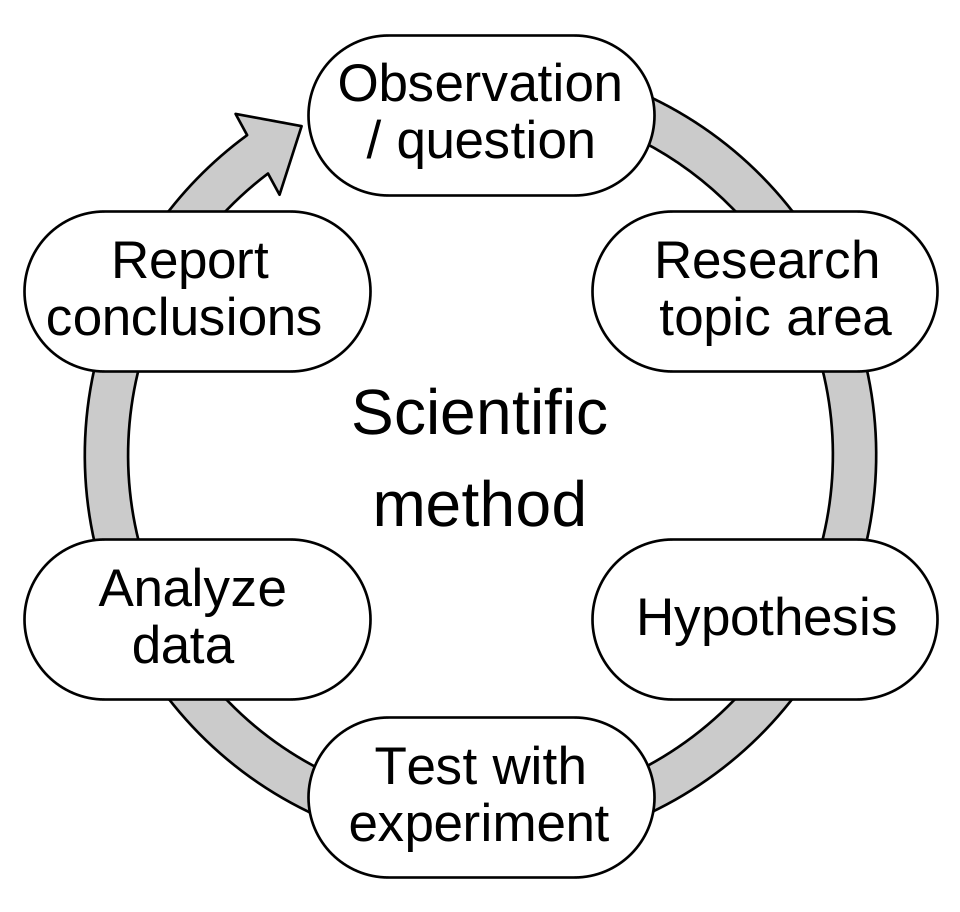 Research is iterative: questions, hypotheses, testing, analysis and revision feed into one another. Image: Efbrazil, Wikimedia Commons, CC BY-SA 4.0.
Recognize common red flags without turning them into automatic rejection rules
Critical reading benefits from red flags, but a red flag is a signal to investigate, not proof that a study is wrong.
Be cautious when the title or conclusion uses stronger causal language than the design supports; when the sample is very small for a noisy outcome; when many outcomes are tested but only one is emphasized; when large percentages are reported without absolute numbers; when subgroup findings dominate despite weak overall evidence; when figures use visually dramatic scales; when important methods are vague; when attrition is high; when the primary outcome changes between protocol and publication; or when conclusions ignore uncertainty.
Other warning signs include claims of a revolutionary effect with little connection to prior literature, journal information that is difficult to verify, missing conflict disclosures in a field where conflicts are plausible, and results that rely entirely on proprietary data or methods that independent researchers cannot inspect. Proprietary research can still be useful, but reproducibility and independent validation become more important.
Also watch your own red flags. Confirmation bias makes supportive papers feel more convincing than opposing ones. Authority bias can make famous institutions or prestigious journals seem infallible. Novelty bias can make surprising findings feel more important than boring replications. Good critical reading applies the same standards to evidence you like and evidence you dislike.
Practice with a worked example
Imagine a hypothetical observational study titled “Daily Green Tea Consumption and Exam Performance in University Students.” The abstract reports that students who drank green tea at least five days per week scored 8% higher on a memory test than students who rarely drank it.
A weak reading would conclude, “Green tea improves memory by 8%.” A stronger reading begins by identifying the design. If students chose whether to drink tea, the study is observational. The result is an association.
Next inspect the sample. Were participants recruited from one university? Were frequent tea drinkers older, more health-conscious, better rested, or more likely to study? Did the researchers measure sleep, caffeine from other sources, socioeconomic factors, and prior academic performance?
Then inspect the outcome. Was “memory” a validated test, course grades, or a custom online quiz? An 8% difference has a different meaning depending on the scale and variability. Look at the confidence interval and sample size.
Check whether the analysis was planned or selected from many dietary variables. If researchers measured coffee, tea, energy drinks, exercise, breakfast, supplements, screen time, sleep, and dozens of outcomes, a single attractive association may need independent confirmation.
Finally, read the discussion. If the authors say “green tea consumption was associated with higher memory scores,” the wording matches the design. If they recommend that students drink green tea to improve exam performance, they have moved beyond what this study alone establishes.
Your final note might read: “Interesting association in a limited student sample; cannot separate tea from lifestyle differences; useful hypothesis for a controlled study, not strong evidence of a causal academic benefit.” That is critical reading: neither dismissive nor credulous.
How to read papers outside your field
Outside your field, your biggest risk is not ignorance itself; it is failing to notice what you do not know. Start with a recent review or high-quality overview before diving into a highly specialized primary paper. Learn the field’s basic outcome measures, common study designs, and major controversies.
When you encounter a method you cannot evaluate, do not pretend that a dense methods section is automatically rigorous. Write the method name down and find an independent explanation of what it measures, its assumptions, and its known limitations.
Pay special attention to words that have technical meanings different from everyday meanings: “significant,” “theory,” “random,” “bias,” “control,” “normal,” “accuracy,” “risk,” and “correlation” are common examples.
If the paper will influence an important decision, seek domain expertise. Reading skills can help you understand evidence, but they do not instantly replace years of specialized training.
How to read a paper when you have only 15 minutes
When time is genuinely limited, use a focused sequence. Spend two minutes on the title, abstract, publication type, and date. Spend three minutes on figures and tables. Spend three minutes identifying the study population, design, comparison, and outcome in Methods. Spend three minutes on the main numerical results and uncertainty. Spend two minutes on limitations and conflicts. Spend the final two minutes writing what the study supports and what it does not.
This shortcut is useful for triage, meetings, or deciding what to read later. It is not enough for making high-stakes claims, reproducing a method, or citing a paper as decisive evidence.
How to read a paper for a literature review
For a literature review, consistency matters more than reading every paper with equal intensity. Define your question and inclusion criteria first. Extract the same fields from each study so comparisons are fair.
Create a table with citation, year, country, design, sample, exposure or intervention, comparison, outcome, follow-up, central result, uncertainty, major limitation, and relevance. Add a column for how the paper relates to others: supports, conflicts, extends, or uses a different population or method.
Do not write your review by summarizing Paper A, then Paper B, then Paper C. Organize around themes, methods, agreements, disagreements, and gaps. Papers are evidence for the structure of your argument; they should not become the structure itself.
How to know when you have understood a paper well enough
You do not need to understand every sentence to understand a paper at the level required for your goal. A useful test is whether you can answer these questions without looking at the PDF:
- What question did the study ask?
- Why did that question matter?
- What kind of study was it?
- Who or what was studied?
- What was measured and compared?
- What was the main finding?
- How large and uncertain was the effect?
- What is the strongest limitation?
- What conclusion is justified?
- What conclusion would go too far?
- How does this paper fit with other evidence?
- What would you want to know next?
If you can answer those clearly, you have probably moved from “I read the words” to “I understand the study.”
A practical 30-minute reading routine
If you want a repeatable habit, use this routine. Minutes 0–5: define your reading question and complete the first-pass scan. Minutes 5–10: identify the research question, paper type, population, and main figures. Minutes 10–20: read the crucial methods and results, focusing on how outcomes were measured and what the numbers show. Minutes 20–25: read the discussion, limitations, funding, and disclosures. Minutes 25–30: write a six-sentence summary in your own words.
The six sentences should cover: the problem; the design; the sample or data; the main result; the strongest limitation; and your current interpretation. If the paper is important, schedule a deeper third pass rather than forcing it into the same session.
Frequently asked questions
Should I read the abstract first or last?
Use it both ways. Read it first to decide whether the paper is relevant and to map the study. After reading the evidence, read it again to see whether its wording fairly represents the full paper. Some experienced readers delay the abstract during deep analysis to reduce framing effects, but there is no single mandatory order.
Do I need to understand every statistical test?
No. You should understand what the test is trying to compare or estimate, what assumptions matter, and how the result affects the claim. If a central conclusion depends on a method you do not understand, learn enough about that method or consult someone who does before relying heavily on the conclusion.
Is a peer-reviewed paper automatically reliable?
No. Peer review can catch problems and improve manuscripts, but errors, bias, weak designs, and overinterpretation can still survive. Treat peer review as one quality-control signal, not a guarantee.
Are preprints useless because they are not peer reviewed?
No. Preprints can contain valuable and timely research, but their preliminary status should increase your caution. Check whether a later journal version exists and whether important methods, numbers, or conclusions changed.
What should I do when two papers disagree?
Compare their designs, populations, measurements, sample sizes, analytical choices, effect sizes, and uncertainty. Then look for systematic reviews, replications, and later studies. Disagreement is often informative because it reveals which conditions or assumptions matter.
Can AI summarize a paper for me?
It can assist, but do not outsource verification. AI systems can omit caveats, misread tables, or invent details. Use AI to clarify specific passages or organize your own notes, and confirm important claims directly in the paper.
Sources and further reading
- NCBI Bookshelf: How To Read A Scientific Manuscript — a structured overview of screening, reading, methods, results, limitations and conflicts.
- PLOS/PMC: Ten Simple Rules for Reading a Scientific Paper — emphasizes questions, figures, critical thinking and active reading.
- National Science Review/PMC: Active versus passive reading — explains why question-driven reading is more efficient than passive linear reading.
- Duke Academic Resource Center: How to Read & Understand a Scientific Article — practical guidance for non-specialists.
- University of Michigan ICPSR: How to Read and Understand a Social Science Journal Article — useful for understanding structure and evidence in social science research.
- Nature, 2026: Seven steps for critically analysing research papers — a recent perspective on systematic critical reading.
Conclusion: read for evidence, not for obedience
The most useful change you can make is simple: stop asking, “How do I get through this paper?” and start asking, “What claim is being made, what evidence supports it, and how strong is that connection?” Scientific papers become less intimidating when you treat them as structured arguments rather than walls of technical language.
Begin with a clear purpose. Screen before reading deeply. Identify the design. Inspect figures and methods. Separate observations from interpretation. Look at effect size and uncertainty, not just significance. Check limitations, conflicts, publication status, and generalizability. Then compare the study with the wider body of evidence.
Your first practical step is to choose one paper you genuinely need to understand and complete a three-line first-pass summary: research question, study design, and main finding. The most important mistake to avoid is believing that the conclusion paragraph can replace your own evaluation. The goal is not to distrust science; it is to understand how scientific confidence is built.