

Behavioral interviews can feel unpredictable because the questions are not asking what you would do in an imaginary situation. They ask for evidence from something you have already done: a difficult deadline, a disagreement, a mistake, an unhappy customer, a project that went off course, a time you persuaded someone, or a moment when you had to make a decision without complete information. The good news is that you do not need a different memorized speech for every possible question. You need a small collection of strong, truthful examples and a reliable way to explain them clearly.
The STAR method—Situation, Task, Action, Result—is one of the most widely taught frameworks for behavioral interviewing. University career centers such as the University of Virginia and the University of Southern California recommend it because it gives candidates a simple structure for telling specific stories while keeping the focus on what they personally did and what happened as a result. The framework is useful, but merely knowing what the four letters mean is not enough. Most weak answers fail because the example is poorly chosen, the context is too long, the action is vague, or the result does not show what changed.
This guide focuses on the harder and more useful part: how to turn your real experience into a flexible interview system. You will learn how to extract likely competencies from a job description, build a story bank, choose evidence that fits each question, shape answers without sounding rehearsed, quantify results honestly, prepare for failures and conflicts, handle probing follow-ups, practice with and without AI, and review your performance after a mock interview. The goal is not to create perfect stories. It is to make your experience easy for an interviewer to understand and evaluate.
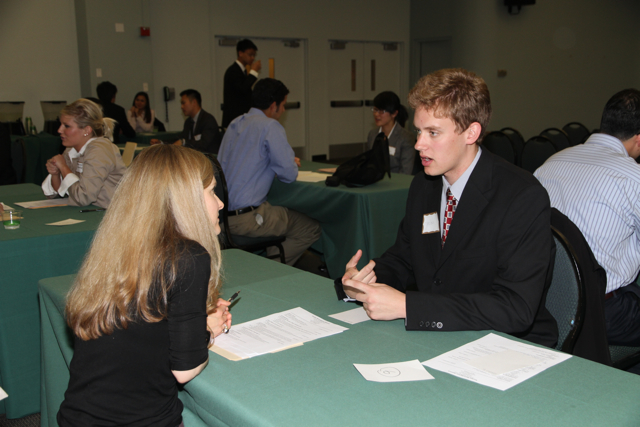 Behavioral interviews work best when answers are specific, evidence-based, and conversational. Image: bpsusf via Wikimedia Commons, CC BY 2.0.
Understand What a Behavioral Interview Is Actually Testing
A behavioral question is designed to learn how you behaved in a real situation. Common openings include “Tell me about a time when…,” “Give me an example of…,” “Describe a situation where…,” and “Walk me through a time you….” The interviewer is usually not interested in the story for its own sake. The story is evidence for a competency such as judgment, communication, leadership, resilience, customer focus, collaboration, ownership, adaptability, planning, or problem solving.
This distinction matters because candidates often answer the surface question while missing the competency underneath it. If you are asked, “Tell me about a time you disagreed with a teammate,” the interviewer may be evaluating how you manage conflict, whether you listen, how you separate the issue from the person, and whether you can reach a workable decision without damaging the relationship. A dramatic disagreement is not automatically a strong example. A smaller disagreement that demonstrates mature reasoning and constructive communication may be more persuasive.
Start your preparation by reading the job description as an evaluation document, not just a list of duties. Highlight repeated verbs and requirements. “Coordinate,” “influence,” “prioritize,” “analyze,” “present,” “own,” “improve,” “support customers,” and “work cross-functionally” all suggest likely behavioral themes. If the role repeatedly mentions ambiguity, expect questions about judgment and adaptability. If it emphasizes clients, expect customer situations. If it emphasizes project ownership, expect questions about deadlines, trade-offs, initiative, and failure.
Create a short competency list with five to eight items. Do not try to predict exact wording. Predict the evidence the interviewer is likely to need. For example, a project coordinator role might require prioritization, stakeholder communication, attention to detail, ownership, teamwork, and recovery from setbacks. A sales role might emphasize persuasion, resilience, customer understanding, goal orientation, and handling objections. A junior analyst role may emphasize structured problem solving, data quality, learning quickly, communication, and accuracy.
How to check whether this step worked: you should be able to look at the job description and write one sentence explaining why each competency matters to the role. If your list consists of generic traits such as “hardworking” and “friendly” without evidence from the posting, refine it. Your story bank will be stronger when it is tied to the employer’s actual needs.
Build a Story Bank Before You Practice Questions
The most efficient way to prepare is to collect experiences first and match them to questions later. If you begin by searching the internet for fifty behavioral interview questions, you may create fifty separate answers and still freeze when the interviewer changes the wording. A story bank gives you reusable raw material.
Start with eight to twelve experiences from work, internships, freelance projects, volunteering, school, student organizations, side projects, sports, community activities, or other settings where you had real responsibility. Experienced candidates should normally prioritize recent professional examples, but early-career candidates do not need to apologize for using academic or volunteer experiences when those examples show relevant behavior.
Look for experiences with movement: something was difficult, uncertain, broken, late, disputed, inefficient, under-resourced, new, or important. Then something changed because of your actions. Strong stories often come from moments such as fixing a process, learning an unfamiliar tool under time pressure, managing competing deadlines, persuading a skeptical stakeholder, repairing a customer relationship, catching an error, taking initiative without being asked, improving an outcome, receiving difficult feedback, recovering from a mistake, helping a teammate, or making a decision with incomplete information.
For each story, write only a compact evidence card rather than a full script. Record: the setting, your responsibility, the problem or goal, three to five actions you personally took, the outcome, and one thing you learned. Add a list of competencies the story could demonstrate. One story may cover several themes. A product launch that slipped behind schedule might demonstrate prioritization, stakeholder communication, problem solving, teamwork, and ownership depending on which part of the story you emphasize.
Use titles that help you remember the event quickly: “Late supplier launch,” “Broken reporting dashboard,” “Difficult client renewal,” “First team lead project,” “Exam-group conflict,” or “Volunteer event budget.” You are building mental retrieval cues. During an interview, you want to hear a question and immediately think, “That sounds like the supplier story,” not search through a memorized paragraph.
A useful story bank should also contain contrast. Do not prepare ten examples where everything went well. Include at least one genuine mistake, one disagreement, one failure or disappointing result, one ambiguous situation, one example of receiving feedback, and one example where you had to learn something quickly. Behavioral interviews often test maturity through imperfect situations. If every story makes you look flawless, your answers may sound selective or unrealistic.
Common mistake: choosing stories because they sound impressive rather than because they show the target behavior. Managing a million-dollar project is not inherently better than fixing a recurring scheduling problem. Interviewers need evidence that you can perform relevant behaviors. Relevance and clarity usually matter more than scale.
Use STAR as a Compression Tool, Not a Script
STAR works because it separates four different jobs your answer has to do. The Situation gives enough context to make the story understandable. The Task explains your responsibility or the outcome you were accountable for. The Action shows what you actually did. The Result closes the loop by explaining what happened and, when useful, what you learned.
The biggest practical improvement is to treat STAR as a compression tool. Your full memory of an event may include weeks of meetings, personalities, background history, technical details, and side issues. The interview answer needs only the information necessary to understand your decisions. If a detail does not help the interviewer understand the challenge, your responsibility, your behavior, or the outcome, it probably does not belong in the first version of the answer.
Situation: Give context without giving a biography
A good Situation is usually two or three sentences. Name the setting, the challenge, and why it mattered. For example: “I was coordinating a website migration for a small e-commerce company. Two weeks before launch, our payment integration began failing in testing, and the vendor estimated a fix that would put the launch date at risk.” That is enough context for the interviewer to understand the stakes.
A weak Situation often lasts a minute before anything happens. Candidates describe the company, team structure, history of the project, every stakeholder, and technical background. The listener is forced to remember many facts before learning what you did. If you regularly run out of time, shorten the beginning first.
Task: Clarify what you personally owned
The Task is not simply “we had to fix it.” Explain your role. Were you responsible for coordinating the response, analyzing the problem, making a recommendation, calming a customer, delivering a deadline, or obtaining approval? This prevents a common ambiguity in team stories: the interviewer hears that the group succeeded but cannot tell what contribution belongs to you.
Keep the Task brief. In many answers, one sentence is enough: “I owned the launch plan, so my job was to determine whether we could protect the date without creating payment risk and keep the marketing and support teams informed.”
Action: Spend most of your time here
The Action is normally the most important section because behavior is what the interviewer is evaluating. Describe decisions and steps, not personality labels. Instead of saying “I communicated well,” explain what you communicated, to whom, when, and why. Instead of “I showed leadership,” explain how you set priorities, involved people, removed blockers, or made a difficult call.
Strong Action sections often show sequence and judgment. “First, I reproduced the failure with the developer so we could separate our configuration from the vendor issue. Then I mapped which checkout paths were affected. I asked the vendor for a daily technical checkpoint and created a fallback launch plan using the previous payment flow. I gave marketing a decision deadline so they would not spend money promoting a launch that might move.” These actions show analysis, coordination, risk management, and communication without needing to claim those qualities.
Use “I” when describing your contribution even if the work was collaborative. That is not selfish; it is precise. You can still credit the team: “Our developer found the root cause, while I coordinated the workaround and stakeholder plan.” The goal is to distinguish your actions from collective outcomes.
Result: Close the evidence loop
The Result should answer “So what?” Explain the outcome in concrete terms when possible. You may mention time saved, defects reduced, revenue protected, customer satisfaction, adoption, completion, accuracy, a deadline met, or a decision made. Not every result needs a number. Qualitative outcomes are valid when the effect is clear: a conflict was resolved, a customer stayed, leadership approved the proposal, or a team adopted a new process.
Use numbers only when you can defend them. Do not invent a percentage because advice online says every answer must be quantified. “We launched on the original date with the fallback flow and switched to the repaired integration four days later without a checkout outage” is stronger than a suspicious claim such as “I improved efficiency by 83 percent” with no basis.
For failure questions, the result may be negative. Say so. Then explain the consequence, what you learned, and what you changed. Mature accountability is often more valuable than forcing every failure into a hidden success story.
 A good interview answer should feel like a clear conversation rather than a memorized performance. Image: Lawrence756 via Wikimedia Commons, CC0.
Map Stories to Competencies Before the Interview
Once you have eight to twelve story cards and a short list of target competencies, build a simple matrix. Put competencies across the top and story names down the side. Mark the strongest matches. The purpose is not to create a rigid one-to-one relationship. It is to make retrieval faster.
Suppose the job emphasizes leadership, prioritization, conflict, communication, problem solving, and learning. Your “late supplier launch” story might be strong for prioritization and communication. Your “reporting error” story might be strong for ownership and problem solving. Your “new software rollout” story might be strong for learning and influence. Your “team disagreement” story may be strongest for conflict and collaboration.
Try to give every major competency at least two possible stories. This matters because interviewers sometimes ask several questions around the same theme. You do not want to reuse the exact same story three times. Having backup examples also protects you if one story turns out to fit the wording poorly.
Then identify your “anchor stories”: three to five experiences you know especially well. The University of Southern California Career Center advises candidates preparing for behavioral interviews to reflect on several accomplishments or projects and know the details because interviewers may ask follow-up questions. Anchor stories are useful because they can often be adapted to multiple competencies without sounding forced.
Test each story with three questions. First, is the event specific? “I often handled difficult customers” is a pattern, not a story. Second, is your contribution visible? If the interesting work was done by someone else, choose another example. Third, is there a meaningful outcome or lesson? An anecdote that ends without change may not provide enough evidence.
If a competency has no good story, do not invent one. Search more broadly through your experience. Early-career candidates can use class projects, volunteer work, family responsibilities, part-time jobs, competitions, clubs, and self-directed projects. The context can be modest if the behavior is genuine. If you truly have no experience with a required behavior, prepare to explain how you would learn rather than manufacturing a past event.
Prepare for the Most Common Behavioral Themes
Leadership without a management title
Leadership questions do not require formal authority. You can demonstrate leadership by creating clarity, taking responsibility, helping a group decide, organizing work, influencing a change, mentoring someone, or stepping into an unowned problem. Focus on what you enabled other people to do rather than presenting leadership as “I told everyone what to do.”
Good evidence includes how you set direction, gathered input, made trade-offs, communicated expectations, and adapted when the original plan failed. If the story involves a team success, be explicit about your contribution while giving appropriate credit to others.
Conflict and disagreement
A conflict answer should show judgment rather than victory. Avoid stories where your main message is that the other person was unreasonable and you proved them wrong. A stronger answer explains the underlying disagreement, what each side cared about, how you listened or gathered evidence, what you proposed, and how the relationship or decision progressed.
If the disagreement was with a manager, do not pretend you always agree. Explain how you raised concerns professionally, what evidence you used, and how you handled the final decision. Interviewers may be looking for whether you can disagree without becoming combative or passive.
Failure, mistakes, and feedback
Choose a real mistake with enough consequence to demonstrate learning but not one that creates an obvious concern about integrity, safety, or a fundamental job requirement. Explain your role without blaming circumstances. Then show what changed in your behavior afterward.
A weak failure answer is a disguised strength: “I care too much,” “I am a perfectionist,” or “I worked too hard.” A stronger example might involve underestimating a task, communicating too late, choosing the wrong approach, missing an assumption, or trying to solve a problem alone for too long. The key is not the mistake itself; it is your diagnosis and correction.
The USC Career Center recommends that when discussing failures, candidates explain what they learned, how their behavior changed, and how they applied that learning later. That final evidence is valuable because it shows the lesson was not merely verbal.
Prioritization and pressure
Do not answer prioritization questions by saying you “worked harder” or stayed late. Interviewers usually want to understand your method. Explain how you assessed urgency, impact, dependencies, deadlines, and stakeholder expectations. Show what you deliberately delayed or renegotiated. Real prioritization means something receives less attention so something more important can receive more.
If you used a tool—calendar blocks, task board, risk register, ticket queue, spreadsheet, or written priority list—mention it only if it helps explain your process. The tool is not the competency. The reasoning behind the choices is.
Problem solving and ambiguity
Strong problem-solving answers reveal how you defined the problem before rushing to a solution. Explain what information you had, what was missing, how you tested assumptions, what options you considered, and why you selected one approach. For analytical roles, you may discuss data quality and validation. For operational roles, you may discuss constraints and dependencies. For customer-facing roles, you may show how you separated symptoms from the underlying need.
When a problem was ambiguous, admit uncertainty. Good judgment often means acting with incomplete information while reducing avoidable risk. You can say, “We did not know whether X was the cause, so I ran a small test before changing the full process.” That is more credible than pretending the right answer was obvious from the beginning.
Turn Weak Answers Into Evidence
One of the best practice methods is to take a vague answer and repeatedly ask, “What did I actually do?” Consider this weak version: “We had a difficult deadline. I motivated the team and communicated with everyone, and we finished successfully.” It contains positive words but almost no evidence.
Improve it by replacing claims with observable actions. “The client moved the deadline forward by five days after a regulatory announcement. I listed the deliverables that were truly required for launch and separated them from improvements that could wait. I met the designer and developer for fifteen minutes each morning to surface blockers, sent the client a written scope change for approval, and moved two lower-priority features to the next release. We delivered the required version on the new date, and the postponed features shipped the following week.”
The second version is stronger because the interviewer can infer prioritization, communication, and ownership. The candidate does not need to announce, “I am an excellent leader.” Evidence allows the listener to reach that conclusion.
Use the same technique with teamwork. “I am a team player” becomes a story about sharing information, resolving dependencies, asking for help early, or helping a colleague while protecting your own deadline. “I am adaptable” becomes an example of changing a plan when assumptions changed. “I am detail oriented” becomes an example of catching a discrepancy and creating a check that prevented recurrence.
During practice, circle every adjective that describes you—proactive, organized, strategic, resilient, collaborative. Then ask whether the surrounding sentence provides behavior that proves it. If not, replace the adjective with evidence.
Keep Answers Concise Without Making Them Shallow
There is no universal time limit for a STAR answer, and interview formats vary. A useful target for many behavioral answers is roughly one and a half to three minutes, but clarity matters more than hitting a stopwatch. Very short answers may not provide enough evidence; very long answers can bury the decision-making.
Practice an expandable version rather than one fixed script. Prepare a concise core that covers the full STAR structure. Then keep extra detail available for follow-up questions. This makes your first answer easier to follow and gives the interviewer room to probe what matters to them.
A simple balance is to spend around 20 to 30 percent of the answer on Situation and Task combined, about half on Actions, and the remainder on Result and learning. These are not rules. They are a diagnostic. If your two-minute answer spends ninety seconds explaining the background, the interviewer may never hear enough about your behavior.
Use signposts naturally when the story is complex: “The main challenge was…,” “My responsibility was…,” “I took three steps…,” and “The result was….” You do not need to say the words Situation, Task, Action, and Result aloud. The framework should organize the answer invisibly.
When technical detail is necessary, translate it to the level required for the role. A software engineer interviewing with engineers may need to explain architecture decisions. The same engineer speaking to a recruiter may need to explain the problem and trade-off in accessible terms. Being concise does not mean removing complexity; it means choosing the complexity the listener needs.
Practice Without Memorizing
Memorization feels safe during preparation but can make an interview more fragile. If the interviewer changes the wording, interrupts, or asks for a different detail, a memorized candidate may lose the thread. A rehearsed script can also flatten natural speech and make genuine examples sound artificial.
Instead, memorize the map, not the sentences. Know the story title, the challenge, your responsibility, three or four action beats, the result, and the lesson. Practice telling the same story in slightly different ways. Answer it once as a leadership question, once as a prioritization question, and once as a communication question. The facts should remain consistent, but the emphasis can change.
Practice aloud. Silent rehearsal hides problems with pacing, breath, jargon, and sentence length. Record yourself on a phone or computer and listen once without judging your voice. Ask practical questions: Can a listener identify the problem quickly? Is it clear what I personally did? Do I explain why I chose those actions? Is there a result? Did I answer the exact question?
Then practice with interruptions. Ask a friend to stop you with questions such as “Why did you choose that?” “What did your manager say?” “How did you measure success?” “What would you do differently?” and “What was your personal contribution?” Real interviews are interactive. Being able to pause, answer, and return to the story is more valuable than delivering an uninterrupted speech.
Use mock interviews in increasing difficulty. First, practice with your notes. Next, use only story titles. Then answer random questions without notes. Finally, simulate the real setting with camera, microphone, clothing, and time constraints if the interview is virtual. The point is not to eliminate nervousness. It is to make retrieval familiar enough that nervousness does not erase your examples.
 Interview skill improves through repeated, realistic practice rather than memorizing one polished script. Image: carmichaellibrary via Wikimedia Commons, CC BY 2.0.
Use AI for Practice Without Letting It Invent Your Experience
AI tools can be useful interview practice partners because they can generate role-specific questions, simulate follow-ups, identify vague sections, and help you compare an answer with a job description. They become harmful when they turn your experience into fictional achievements or produce language you cannot naturally defend.
A safe workflow begins with your own facts. Give the tool a job description and a list of real story cards with sensitive details removed. Ask it to identify which competencies each story could demonstrate and generate behavioral questions that might test those competencies. Then answer in your own words. Ask the tool to critique clarity, specificity, relevance, and whether the Action section shows your contribution.
Do not ask an AI system to “make this answer more impressive” without constraints. It may add numbers, responsibilities, or outcomes that never happened. Instead, ask: “Do not add facts. Point out where this answer is vague and ask me questions that would help me add truthful detail.” This keeps the tool in the role of interviewer or editor rather than ghostwriter of your history.
You can also use AI to simulate follow-ups. After giving a truthful answer, ask the tool to behave like a skeptical interviewer and ask five questions about decisions, trade-offs, measurement, collaboration, and lessons. If you cannot answer a follow-up without inventing details, your original story may be too weak or you may need to review the facts.
Protect confidential information. Do not paste proprietary data, customer names, unreleased product details, personal employee information, trade secrets, or sensitive internal documents into a public AI service. Generalize names and numbers when necessary. You can practice “a regional client” or “a six-person project team” without exposing information your employer expects you to protect.
A good final test is whether you could tell the same story to a former colleague who was present without feeling that you exaggerated it. Interview preparation should improve communication, not rewrite reality.
Handle Questions About Failure, Conflict, and Weak Outcomes
Some candidates prepare only success stories because they believe every answer must end with a win. That creates a problem when the interviewer explicitly asks about failure, criticism, disagreement, or a decision that did not work. Trying to twist a success into a fake failure often signals poor self-awareness.
For a mistake, use a direct structure. State what went wrong. Clarify your responsibility. Explain how you recognized the issue. Describe the immediate corrective action. Then explain what process, habit, or decision rule changed afterward. If possible, provide evidence that the change worked in a later situation.
For example: “I underestimated the review time for a client report and promised a delivery date without checking the availability of our subject-matter reviewer. We missed the original deadline by one day. I told the client as soon as I knew, took responsibility, and gave a revised time rather than making another optimistic promise. Afterward I added reviewer availability as a dependency in our planning template and stopped confirming external deadlines until that dependency was checked. On the next three reports we built review time into the schedule and delivered as planned.”
The answer is not impressive because the mistake was dramatic. It is credible because the candidate identifies the behavior that caused the problem and shows a changed system.
For conflict, avoid diagnosing the other person. Describe the disagreement in neutral terms. “We disagreed about whether to launch with a manual approval step” is better than “My colleague was stubborn and refused to listen.” Explain what information each side had, what you did to understand the concern, and how the group reached a decision. If the conflict was not fully resolved, say what you learned about working together despite disagreement.
For a weak outcome, do not inflate the result. Perhaps the project was canceled, the customer left, the proposal was rejected, or the metric improved less than expected. Explain what your actions achieved despite the overall outcome and what you would change. Interviewers often care about the quality of reasoning under imperfect conditions.
Prepare for Follow-Up Questions
Follow-ups are not necessarily a sign that your answer failed. A good interviewer may probe because the story is relevant and they want more evidence. Prepare for the details most likely to be tested.
Expect questions about scale: How many people were involved? How long did it take? How large was the budget or customer group? You do not need exact figures if you do not remember; give an honest approximation and label it as such.
Expect questions about decision-making: What alternatives did you consider? Why did you choose that approach? What information was missing? What risk worried you most? These questions distinguish someone who participated in an event from someone who understood their decisions.
Expect questions about personal contribution: What specifically did you do? Who made the final decision? What did your manager do? What did the team do? Be precise. Collaborative work is not a weakness, but claiming the entire team’s output as your own can undermine trust.
Expect questions about measurement: How did you know it worked? What changed? What feedback did you receive? If no formal metric existed, explain the evidence you did have, such as reduced complaints, approval from a stakeholder, fewer errors, completion before a deadline, adoption by a team, or a clear operational change.
Expect reflection questions: What would you do differently? What did you learn? Have you used that lesson again? Avoid the lazy answer “I would not change anything.” Even successful projects contain trade-offs or improvements. Reflection signals that you can learn after action.
The best preparation is to review each anchor story from multiple angles. Write down the people, timeline, key constraints, important decisions, result, and lesson. You should not memorize these facts, but you should know them well enough that follow-ups do not force you to reconstruct the event under pressure.
Adapt STAR for Different Career Levels
STAR should not sound identical for a student, an individual contributor, and a senior manager. The structure stays useful, but the evidence changes.
Students and recent graduates can use class projects, internships, campus organizations, part-time work, volunteering, competitions, and self-directed projects. Choose examples where you made decisions and dealt with real constraints. Avoid apologizing for not having ten years of experience. Instead, make the behavior visible. A group project can demonstrate conflict resolution if you actually resolved a conflict; it is weak if the story is merely “we divided the work and got an A.”
Mid-career individual contributors should normally emphasize recent professional examples and increasing scope. Show how you solve problems independently, influence peers, manage stakeholders, improve processes, and make trade-offs. If every example comes from your first job many years ago, the interviewer may wonder why your recent experience is less relevant.
Managers should include the behavior of leading through others. A manager’s Action section should not consist entirely of “I assigned tasks.” Explain how you diagnosed team needs, set direction, coached performance, made decisions, built alignment, changed a process, or handled accountability. Results may include team performance, retention, delivery, quality, capability, or improved decision-making.
Senior leaders should be ready to explain complexity: competing stakeholders, incomplete information, organizational trade-offs, long time horizons, and second-order effects. They should also be explicit about what they personally decided versus what their teams executed. Strategic language without concrete decisions can sound abstract.
Career changers can use examples from a previous industry when the competency transfers. Do not force every story to resemble the new job. Explain the transferable behavior. A teacher moving into customer success may have strong examples of communication, needs diagnosis, conflict management, planning, and adapting explanations to different audiences. A military candidate moving into operations may have examples of logistics, leadership, risk management, training, and execution under constraints. Translate context without erasing what made the experience real.
Prepare for Virtual Behavioral Interviews
Virtual interviews add technical and environmental failure points. Test the exact platform if possible, not just your camera app. Check microphone input, camera framing, headphones, charging, browser permissions, internet stability, and the display name on your account. Keep the interviewer’s phone number or recruiting email accessible in case the connection fails.
Place your camera near eye level and use a stable surface. You do not need a studio background, but remove obvious distractions. Put light in front of you rather than directly behind you when possible. Close unnecessary applications and notifications so a private message does not appear during screen sharing or distract you mid-answer.
Notes can help, but do not put full scripts on the screen. Use a one-page story map with short titles and perhaps one result metric. If your eyes repeatedly move to paragraphs of text, the interview may feel like a reading exercise. The same principle applies to in-person interviews: notes should support recall, not replace conversation.
Virtual delay can cause accidental interruptions. Leave a small pause after the interviewer finishes a question. If you interrupt, simply say, “Sorry—please finish,” and continue. Do not let a minor conversational glitch destabilize the rest of the interview.
If technology fails, communicate clearly. Rejoin, use the backup method, or email promptly. A technical problem is usually less damaging than disappearing without explanation. Your response to the failure may itself demonstrate composure and communication.
Create a 48-Hour Preparation Plan
If your interview is close, do not spend the remaining time consuming endless tips. Use a focused plan that produces evidence you can retrieve.
Forty-eight hours before: read the job description and company information. Identify six to eight competencies. Build or review eight to twelve story cards. Mark two stories for each major competency. Review your resume because interviewers may use any bullet as a prompt for a behavioral follow-up.
Twenty-four hours before: practice six to ten random behavioral questions aloud. Record at least three answers. Shorten any story with excessive setup. Add truthful detail where Actions are vague. Review failure, conflict, feedback, and prioritization stories because these are easy to neglect. Prepare questions you want to ask the interviewer.
The evening before: stop major rewriting. Verify logistics, meeting link, route, time zone, clothing, documents, portfolio access, and technology. Review story titles, not scripts. Sleep is more useful than another two hours of memorizing sentences you may never use.
Thirty minutes before: avoid cramming. Read the competency list and story titles once. Have water available. Close distractions. Remind yourself that you do not need to predict the exact questions; you need to listen and select relevant evidence.
During the interview: listen to the whole question. If it is broad, take a few seconds to choose a story. It is acceptable to say, “Let me think of the most relevant example.” If you are unsure what the interviewer means, ask a concise clarifying question rather than answering the wrong problem.
After the interview: write down the questions you remember, which stories you used, where you felt unclear, and any follow-ups that exposed weak preparation. This turns every real interview into data for the next one. Do not obsess over minor wording. Look for patterns: overly long setup, weak results, repeated examples, or trouble describing your personal contribution.
What to Do When You Do Not Have a Perfect Example
Sometimes a question targets an experience you have never had. Do not force a weak story to fit. First, look for a smaller version of the competency. If you have never managed a formal budget, perhaps you managed limited resources or made cost trade-offs. If you have never supervised an employee, perhaps you led a project, mentored a peer, coordinated volunteers, or influenced without authority.
If you truly lack the experience, say so briefly and redirect to the closest relevant evidence. For example: “I have not directly managed a full-time employee yet, but I have led project teams where I had to set expectations and give feedback. One example was…” This is more credible than pretending informal coordination was formal people management.
For highly specific scenarios, you can answer with a real analogous example and then explain how you would transfer the lesson. Keep the behavioral evidence separate from hypothetical reasoning. The interviewer asked about the past because they want evidence; give them as much real evidence as you honestly can.
Do not reject useful non-work examples automatically. If you are early in your career, a serious volunteer project with deadlines, stakeholders, and consequences may be stronger than a trivial office example. The key is whether the behavior resembles what the employer needs.
Questions to Ask Yourself Before You Use a Story
- Is it true? Could I defend every important fact if the interviewer asks for detail?
- Is it specific? Does it describe one event rather than what I “usually” do?
- Is it relevant? Does it demonstrate the competency behind the question?
- Is my role clear? Can the interviewer distinguish my work from the team’s work?
- Do my actions show judgment? Have I explained why I chose the approach, not just what happened?
- Is there an outcome? Can I explain what changed, what was learned, or how success was assessed?
- Can I discuss the people respectfully? Conflict stories should not become complaints about former colleagues.
- Can I share it? Remove confidential or personally sensitive information when necessary.
- Can I shorten it? If the interviewer asks for a concise example, can I tell the core story in about a minute?
- Can I expand it? If they probe, do I know enough detail to answer follow-up questions?
Frequently Asked Questions
Do I have to use STAR for every interview question?
No. STAR is most useful for behavioral questions that ask for a real example. It is usually unnecessary for simple factual questions such as “Which software have you used?” or motivational questions such as “Why are you interested in this role?” You can still use structured evidence when helpful, but forcing every answer into four parts can make conversation unnatural.
Can I reuse the same story more than once?
Yes, but avoid relying on one example throughout the entire interview. A strong story can demonstrate different competencies, and the USC Career Center notes that one scenario may answer multiple kinds of behavioral questions. However, varied examples show broader evidence and reduce repetition. Prepare several anchor stories and backups.
What if I cannot remember exact numbers?
Do not invent them. Use a truthful approximation when appropriate—“about twenty customers,” “roughly two weeks,” or “a small team of five”—and signal that it is approximate. If no useful number exists, describe the concrete outcome in words. Credibility is more important than forced quantification.
Should I memorize my STAR answers word for word?
Usually no. Memorize the facts and action sequence, then practice telling the story naturally. Word-for-word memorization can make you brittle when an interviewer interrupts or changes the question. A story card with short prompts is more flexible than a paragraph script.
How many STAR stories should I prepare?
For many interviews, eight to twelve varied stories provide a practical starting point, with three to five especially strong anchor stories you know in detail. The exact number depends on your experience and the interview length. Coverage matters more than volume: make sure you can address the major competencies in the job description plus failure, conflict, learning, and prioritization.
Can students use university or volunteer examples?
Yes. Use examples that involve genuine responsibility, choices, constraints, and outcomes. Explain the context briefly and focus on transferable behavior. As you gain professional experience, gradually replace older academic examples with stronger recent work examples.
What if my result was not successful?
Say so honestly when the question calls for it. Explain the consequence, what you learned, and what you changed. A thoughtful failure story can demonstrate more maturity than a forced success story. The interviewer is often evaluating accountability and learning, not demanding that every past decision worked.
Can AI write my interview answers for me?
It can help structure and critique answers, but it should not invent your history. Give it truthful facts, ask it to identify vagueness, and use it for question generation or follow-up practice. Never adopt achievements, numbers, or responsibilities that did not happen, and avoid sharing confidential employer information with tools that are not approved for that data.
A Practical Final Review
The strongest behavioral interview preparation is not a collection of clever phrases. It is organized recall. Read the job description until you understand the behaviors the employer is likely to evaluate. Build a small set of truthful experiences. Use STAR to remove irrelevant detail and make your decisions visible. Practice the stories in different forms so you can adapt instead of recite. Prepare for uncomfortable themes—failure, conflict, criticism, ambiguity—because those examples often reveal the most about how you work.
If you do only one thing today, create your first eight story cards. Do not write polished paragraphs. Write the setting, responsibility, three actions, result, lesson, and the competencies each story could demonstrate. That exercise will give you more usable interview material than memorizing dozens of model answers.
The most important mistake to avoid is replacing evidence with adjectives. You do not need to tell the interviewer that you are collaborative, resilient, strategic, or organized. Give them a clear example in which your actions demonstrate those qualities. Specific behavior is easier to trust, easier to remember, and easier to evaluate.
Sources and Further Reading
- University of Virginia Career Center — STAR Method
- University of Southern California Career Center — Prepare for an Interview
- UC Davis Career Center — Interview Questions and How to Prepare
- The Citadel Career Center — Interview Preparation
- University of Virginia Career Center — S.T.A.R. Method for Behavioral Interviews
- Wikimedia Commons — Job interview 0001.jpg, CC BY 2.0
- Wikimedia Commons — Interview Session.jpg, CC0
- Wikimedia Commons — Career Fair (3344906898).jpg, CC BY 2.0