

When an exam is several weeks away, the problem usually does not look like a lack of material. It looks like too much material: lecture slides, textbook chapters, problem sets, flashcards, old quizzes, practice papers, and a calendar already crowded with classes, work, commuting, meals, and ordinary life. A useful study schedule solves that problem by converting a vague goal such as “study biology” into a sequence of specific learning jobs that can actually be completed and checked.
The strongest schedule is not the one with the most hours. It is the one that repeatedly brings important material back into your attention, forces you to retrieve and use what you know, gives weak topics more practice than strong ones, and still leaves enough flexibility to recover when a day goes badly. Research reviews have consistently rated practice testing and distributed practice among the most broadly useful learning techniques, while simply rereading or highlighting tends to be less powerful when used alone. That means the calendar should be designed around what your brain does during the session, not just around sitting at a desk for a certain amount of time.
 A study schedule works best when each session has a concrete task and a clear finish line. Photo: Heidy Garcia, CC BY 4.0, via Wikimedia Commons.
Start with the exam, not with your calendar
Before you divide evenings into neat blocks, define what the exam actually demands. Two courses can contain the same number of chapters but require very different preparation. A history exam may reward accurate recall plus the ability to compare causes and consequences. A calculus exam may require fast recognition of problem types and correct multi-step procedures. A language exam may combine vocabulary, listening, grammar, and written production. A nursing, engineering, accounting, or computer-science exam may mix factual knowledge with applied problems.
Your first job is therefore to make an exam map. Collect the syllabus, assessment guide, instructor announcements, lecture objectives, past papers if they are legitimately available, graded quizzes, assignment feedback, and any official list of examinable topics. Write down the exam date, start time, format, duration, permitted materials, and weighting. If there are multiple exams, do this for each one on the same page.
Next, list the content at a useful level of detail. “Chemistry” is too broad. “Acid-base equilibria,” “buffer calculations,” “titration curves,” and “solubility equilibria” are better. “Chapter 7” is sometimes too mechanical because a single chapter may contain three very different skills. The test for a good topic label is simple: you should be able to imagine a question that tests it.
For each topic, mark four things:
- Importance: How likely is it to appear, or how much of the course does it represent?
- Current strength: Can you explain it or solve representative questions without notes?
- Work type: Is it mainly recall, conceptual explanation, calculation, interpretation, writing, or a mixture?
- Dependency: Does another topic depend on mastering this one first?
A useful quick rating is High, Medium, or Low for importance and Strong, Developing, or Weak for current mastery. Do not spend an hour inventing a complicated scoring model. The purpose is to decide where your time should go.
How to check whether your self-rating is honest
Students often rate a topic as “fine” because the notes look familiar. Familiarity is not the same as retrieval. Close the notes and answer three representative questions, explain the idea aloud from memory, or solve a problem without looking at the worked example. If you cannot produce the answer, the topic belongs in the schedule even if it feels recognizable.
Common mistake: planning from the textbook table of contents without checking the actual assessment. This can produce hours of work on low-value material while important question types receive little practice.
If the exam scope is unclear: use the official learning objectives and recent teaching emphasis, then ask the instructor through the normal course channel if clarification is permitted. Do not build the whole plan around rumors about what “always comes up.”
Calculate your real study capacity
Once the exam map exists, look at your calendar. The important word is real. A schedule that assumes you can study six hours every weekday when you have classes until 5 p.m. and a long commute is not ambitious; it is unusable.
Work from fixed commitments outward. Mark classes, work shifts, appointments, commuting, meals, regular exercise, family responsibilities, and a realistic sleep window. Then identify the remaining periods in which focused study is plausible. Some people have a useful 45-minute window before class. Others have two strong evening hours but very little useful concentration late at night. Your plan should reflect the person who will actually execute it.
Estimate capacity in focus blocks rather than grand totals. A focus block can be 25, 40, 50, 60, or 90 minutes depending on the work. A difficult problem set may need a longer uninterrupted block; vocabulary retrieval may work well in shorter sessions. The exact block length is less important than having a defined task, working with attention, and taking a genuine break before the next demanding block.
Do not allocate 100% of available time. Leave approximately one block every few days, or a larger weekly buffer, for work that overruns, illness, unexpected assignments, or topics that turn out to be harder than expected. A schedule with no slack collapses after the first disruption.
A simple capacity example
Suppose you have 14 days before an exam. After fixed commitments, you can realistically complete two focused blocks on Monday through Thursday, three blocks on Friday, four on Saturday, and three on Sunday. That is 18 blocks per week, or 36 over two weeks. Instead of writing “36 hours,” you now have 36 slots that can be assigned to concrete work.
You might reserve four of those blocks as buffer and two for full or partial practice exams. That leaves 30 blocks for learning and review. This immediately forces useful prioritization: a syllabus with ten major topics cannot receive ten blocks each, so weak and high-value topics must be identified.
Turn topics into specific study tasks
“Study chapter 4” is a poor calendar item because it gives you no method and no stopping rule. Better tasks describe an action and an output. Examples include:
- Answer 25 retrieval questions on cell respiration without notes, then correct errors.
- Solve six integration problems of mixed types and record the error pattern for any incorrect solutions.
- Explain three causes of the event from memory, then write one compare-and-contrast paragraph.
- Recall 40 vocabulary items, separate missed cards, and retest only the misses after a delay.
- Complete one timed essay plan in 15 minutes and compare it with the marking criteria.
Each task should have a finish line. That might be a number of questions, a set of objectives, a completed concept explanation, a practice section, or a documented error list. Without a finish line, study sessions tend to drift toward passive reading because passive reading is easy to continue indefinitely.
Build the schedule around retrieval, not exposure
One of the most important design choices is to separate learning input from retrieval output. Input means reading, watching, listening, or reviewing a worked example. Retrieval means trying to produce the knowledge or procedure without having the answer in front of you.
Input is necessary when you do not yet understand something. But once the basic explanation is available, your schedule should repeatedly ask you to bring the idea back from memory or use it in a problem. The major review by Dunlosky and colleagues rated practice testing and distributed practice as high-utility techniques across many kinds of learners and tasks. A later meta-analysis of the same family of techniques likewise found distributed practice and practice testing among the strongest approaches in the evidence base.
In practical terms, that means a session should rarely be “read the chapter again.” A stronger version is “read the two pages needed to fix an identified gap, close the book, answer five questions, then check.” The notes are used as a correction tool rather than as the entire activity.
Retrieval methods for different subjects
Fact-heavy subjects: use short-answer questions, flashcards, blank-page recall, labeling diagrams from memory, or oral questioning. Avoid cards that merely ask you to recognize a term among options if the exam expects you to produce it.
Problem-solving subjects: solve fresh problems without following a worked example line by line. Afterward, compare your method, identify the exact step where an error occurred, and redo a similar problem later.
Essay subjects: retrieve arguments, evidence, examples, and counterarguments. Practice generating outlines from a prompt under time pressure. Full essays are useful, but quick plans allow more retrieval repetitions in limited time.
Languages: combine recognition with production. Translate in both directions when appropriate, produce sentences, recall vocabulary, practice listening without a transcript first, and use spaced review for items you repeatedly miss.
Diagram or process subjects: redraw the process from memory, label a blank diagram, explain the sequence aloud, then compare it with the authoritative version.
Use spacing so important material comes back before the exam
If you study a topic once on day one and never touch it again until the exam, the first session has to carry too much weight. Spacing solves this by scheduling multiple contacts separated in time. The precise “perfect interval” is not universal: it depends on how long you need to retain the material and how well it is already learned. Research on spacing shows that the timing between learning events matters, and that longer desired retention generally calls for longer gaps between reviews.
For ordinary exam planning, you do not need an algorithm. Use a simple rule: after a meaningful first session, bring the topic back relatively soon, then again after a longer gap, and again near the exam if it remains important. A 14-day plan might revisit a difficult topic on days 1, 3, 7, and 12. A topic already strong may only need checks on days 2, 8, and 13. The reviews do not need to be equally long. A 50-minute learning session may be followed by a 20-minute retrieval check.
The value of spacing is not merely calendar variety. The gap creates some forgetting, which makes successful retrieval more effortful. That effort can strengthen later access to the knowledge. However, a gap that is so long that you repeatedly fail everything may be inefficient. Adjust based on performance.
 Condensed notes can support review, but the schedule should repeatedly turn those notes into questions and retrieval attempts. Photo: Drummyfish, CC0, via Wikimedia Commons.
A practical spacing pattern
For a topic you are learning from scratch:
- Session A: understand the core idea and perform a first retrieval attempt.
- Session B, one to three days later: retrieve again before reopening notes; practice a different example.
- Session C, several days later: mix the topic with other material and test discrimination between similar ideas.
- Session D near the exam: use a short, exam-like check rather than another long review.
If Session B is nearly perfect, Session C can move farther away or shrink. If Session B is poor, schedule another short retrieval sooner. This is how the calendar becomes adaptive rather than decorative.
Mix related problem types after the basics are stable
Many students practice in blocks: ten identical quadratic problems, then ten identical probability problems. Blocked practice can be useful while learning a procedure because it reduces the number of decisions you must make. But exams usually do not tell you which method to use. The question itself is the cue.
After you can perform each method separately, begin mixed practice. Combine several related problem types and make yourself decide which approach applies. This is especially useful in mathematics, statistics, physics, chemistry, grammar, accounting, programming, and any course in which choosing the method is part of the assessment.
Do not mix everything from the start. A beginner who cannot yet execute method A gains little from constantly switching among A, B, C, and D. First establish the procedures, then mix them to practice selection.
Create a priority system that changes as you learn
A static schedule often wastes time because it keeps assigning equal study to topics that no longer deserve equal attention. Use a simple three-zone system after each retrieval session:
- Red: cannot explain or solve without substantial help.
- Amber: partially correct, slow, uncertain, or inconsistent.
- Green: accurate under realistic conditions on more than one occasion.
Red topics receive earlier and more frequent blocks. Amber topics receive spaced checks and varied practice. Green topics stay in the schedule but with shorter, less frequent checks. A topic does not become green because you read it fluently. It becomes green because you can retrieve or apply it.
At the end of each day, spend two minutes updating these labels. This tiny feedback loop prevents a common failure: continuing to study your favorite topics because they feel productive while avoiding the areas that actually threaten your score.
Plan the first pass, the consolidation pass, and the exam pass
Instead of scattering tasks randomly across the calendar, divide the preparation period into three functional phases. The phases can overlap, especially if the exam is close.
Phase 1: Coverage and diagnosis
The objective is to touch every examinable area early enough to discover surprises. You are not trying to perfect everything. You are finding out which topics are strong, which are weak, and which resources are missing.
During this phase, complete diagnostic questions before doing long reviews whenever possible. If you can already solve a topic accurately, do not spend two hours re-learning it from the beginning.
Phase 2: Consolidation and repeated retrieval
This is where most of the schedule should live. Weak areas receive targeted explanation followed by retrieval. Stronger areas return through shorter spaced checks. Similar topics begin to mix together. Your error log becomes increasingly important.
Phase 3: Exam simulation and final correction
Near the exam, shift toward the actual conditions you must perform under. Complete timed sections or full papers when appropriate. Practice producing answers without constant access to notes. Review errors, but avoid turning the final day into a frantic attempt to relearn the entire course.
The final phase should also confirm logistics: exam time, location or online access, permitted calculator or materials, identification requirements, and any submission rules. Academic preparation is wasted if avoidable logistical mistakes consume attention on exam day.
Use an error log instead of repeatedly starting over
An error log is one of the highest-value tools in an exam schedule because it records what your practice is teaching you about your weaknesses. It does not need to be elaborate. A spreadsheet, notebook page, or simple document can include:
- Date
- Topic
- Question or task type
- What went wrong
- Why it went wrong
- Correct rule or method
- When you will retest it
The “why” column matters. “Wrong answer” is not a diagnosis. Better categories include: forgot a definition, confused two similar concepts, chose the wrong formula, algebra error, misread the question, ran out of time, omitted evidence, failed to check units, or knew the method but could not recall the first step.
Different causes need different fixes. If you forgot a definition, retrieval practice may be enough. If you repeatedly choose the wrong formula, you may need mixed problems that train method selection. If you understand essays but run out of time, the schedule needs timed planning and writing rather than more reading.
Decide what belongs on flashcards—and what does not
Flashcards are useful when a prompt can meaningfully cue a piece of knowledge you need to retrieve: vocabulary, definitions, formulas, anatomy labels, dates, classifications, command syntax, common error conditions, or short conceptual questions. They become less useful when you force an entire essay or multi-page process onto one card.
Good cards are specific. “Everything about photosynthesis” is not a card; it is a topic. “What are the inputs and outputs of the light-dependent reactions?” is a retrievable question. For procedural subjects, cards can remind you of decision rules, but they should not replace solving full problems.
If you use a spaced-repetition app, let it handle individual card intervals, but do not surrender your entire exam plan to the app. The exam may require integration, writing, calculations, diagrams, or long-form reasoning that flashcards cannot simulate.
Protect the schedule from distraction before the session starts
Focus problems are easier to manage through environment design than through repeated acts of willpower. Before a block begins, put the required materials on the desk, close unrelated browser tabs, silence nonessential notifications, and move the phone out of easy reach if it repeatedly interrupts you. Decide the first question before the timer starts.
A study block that begins with ten minutes of deciding what to do is partly a planning block. Planning is legitimate, but schedule it separately. Your daily plan should make the first action obvious: “Open problem set 4 and solve questions 1–6 without notes” is much easier to start than “do physics.”
If you need the internet for research or lectures, create a small list of sites or files needed for the task. When an unrelated question occurs, write it on a “later” list instead of immediately searching it.
Use breaks to sustain work, not to disappear from it
Breaks are not a reward for weakness. They are part of designing a session that you can repeat. Stand up, drink water, stretch, look away from the screen, or take a short walk. Be careful with activities that are difficult to stop, such as opening an endless social feed “for five minutes.” If that repeatedly turns a short break into 40 minutes, choose a different break activity.
Longer sessions are not automatically better. When accuracy falls sharply, reading becomes mechanical, or you are solving the same line three times, the useful work may already be over. Record where you stopped and resume with a fresh retrieval attempt later.
Build practice exams into the calendar early enough to learn from them
A practice paper completed the night before the exam can reveal problems but leaves little time to fix them. Schedule the first substantial exam simulation early enough that its results can change the rest of the plan.
Use authentic past papers when they are officially provided, or construct a mixed set from legitimate course materials. Match the real conditions as closely as useful: time limit, calculator rules, closed or open book, expected answer length, and order of sections. If a full paper is too long, complete a timed section.
Afterward, spend serious time on review. Classify every lost mark. Which topics failed? Which mistakes were knowledge problems? Which were method-selection problems? Which came from time pressure? Then edit the calendar. A practice exam that does not change what you do next is only half used.
How to schedule multiple exams without neglecting the later one
When exams are clustered, students often devote nearly everything to the first exam and then discover that the second course has been untouched for a week. Use a weighted rotation.
Give more blocks to the nearer, harder, or more heavily weighted exam, but preserve maintenance blocks for later exams. For example, with Exam A in six days and Exam B in ten days, a day with three blocks might contain two for A and one for B. After A is complete, the balance shifts heavily toward B.
Topics that require long-term memory—vocabulary, equations, terminology, case facts—benefit from these maintenance reviews because they keep the material active while another exam receives most of the attention.
What to do when you are behind
Do not “catch up” by copying every missed task onto the next day. That produces an impossible pile and turns one bad day into four. Instead, re-triage.
- Delete or shorten low-priority tasks.
- Protect high-weight weak topics.
- Combine review tasks when sensible.
- Use buffer blocks you intentionally reserved.
- Preserve at least one exam-like practice opportunity.
If time has become very short, prioritize retrieval of high-yield material and representative problems over beautifully reorganizing notes. A perfect set of notes produced too late is less useful than imperfect notes that have already generated several rounds of recall.
How to make a seven-day exam study schedule
Seven days is enough time to create spacing, diagnosis, and exam practice if you resist the temptation to spend the first four days passively reviewing everything.
Day 1: Map and diagnose
Confirm scope, list topics, complete short diagnostic questions, and label each topic red, amber, or green. Begin one or two high-priority red topics. Create the error log.
Day 2: First targeted learning
Work on the largest weak area and a second important topic. End both with closed-note retrieval. Add a short review of one topic from Day 1.
Day 3: Expand coverage and revisit
Cover another weak or high-weight topic. Retrieve material from Days 1 and 2. Begin mixing similar problem types if the basics are stable.
Day 4: Practice under partial exam conditions
Complete a timed section or mixed question set. Review the errors immediately enough to remember what you were thinking. Reclassify priorities.
Day 5: Repair weaknesses
Use the error log to target the three most costly problems. Do not start with the easiest material simply to build confidence. Finish with a short retrieval check of older topics.
Day 6: Exam simulation
Complete the closest practical version of the real assessment. Grade it using official answers, rubrics, or course guidance where available. Correct every error and write a final short list of fragile areas.
Day 7: Light consolidation and logistics
Retrieve the fragile areas, review formulas or core facts that genuinely require memorization, and complete a few representative questions. Avoid replacing sleep with an all-night attempt to relearn the course. Prepare what you need for the exam and stop early enough to arrive mentally functional.
How to make a four-week study schedule
With four weeks, you can create a much stronger spacing pattern. Week 1 should diagnose and establish coverage. Week 2 should deepen understanding and begin repeated retrieval. Week 3 should increase mixed and exam-style practice. Week 4 should concentrate on simulation, correction, and maintaining important material.
A useful weekly rhythm is:
- Monday–Thursday: new or weak topics plus short spaced reviews.
- Friday: mixed retrieval and error-log cleanup.
- Weekend: longer problem sets, essays, labs, or practice-paper sections, followed by schedule adjustment.
The key advantage of four weeks is not that you can study four times longer. It is that you can meet important material on several different days, forget some of it, retrieve it again, and discover weaknesses while there is still time to correct them.
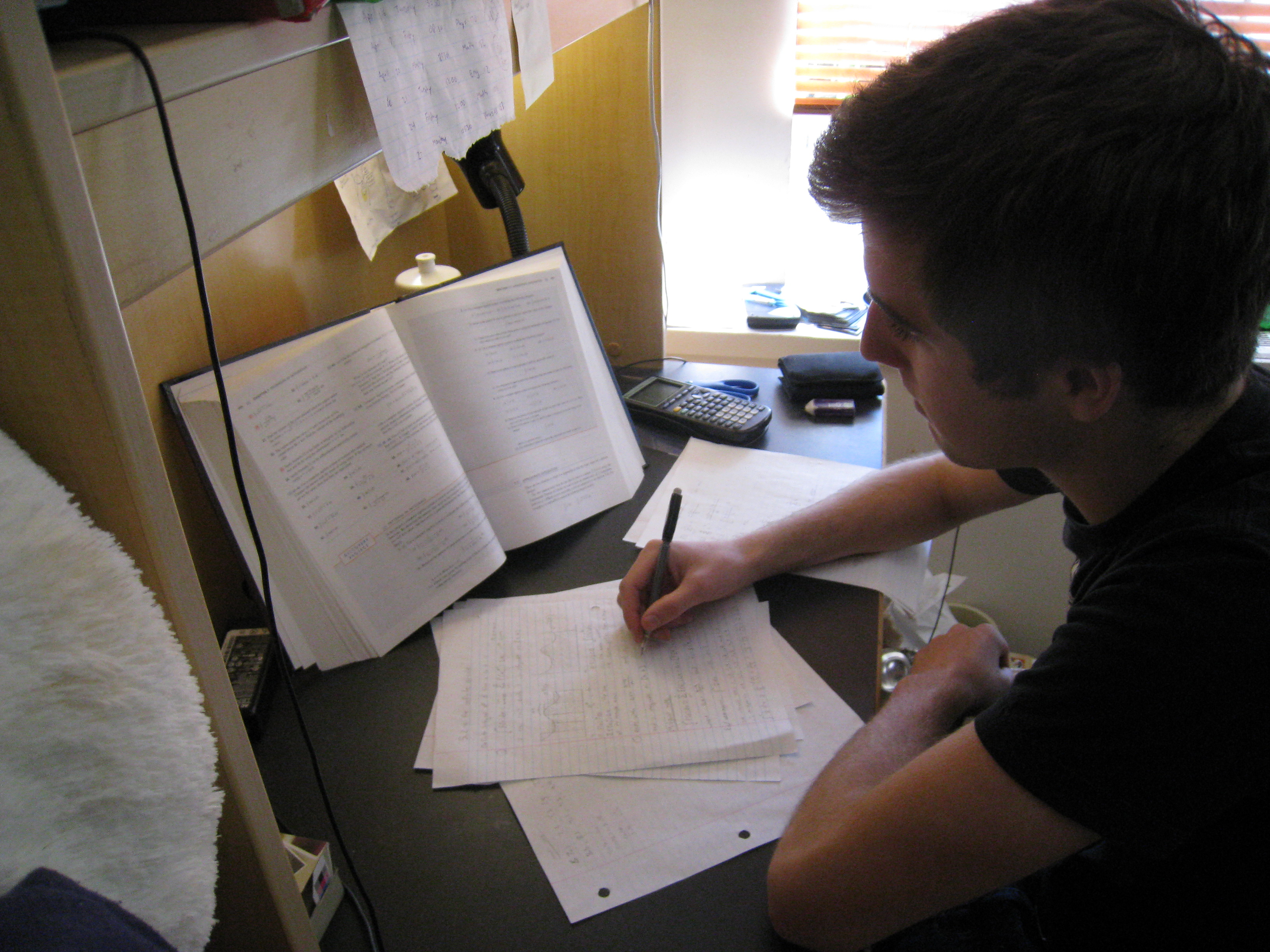 Mix input with output: learn what you need, then close the source and produce an answer, explanation, diagram, or solution. Photo: Gnarlycraig, public domain, via Wikimedia Commons.
A worked example: three exams in twelve days
Imagine a student has Statistics on Day 6, Biology on Day 9, and History on Day 12. Statistics is currently weakest, Biology is medium, and History is strongest but contains a large amount of factual material.
The student has three blocks available on weekdays and five on each weekend day. Instead of giving every subject equal time, the first five days might use roughly half of the blocks for Statistics, one third for Biology, and the remainder for short History retrieval. Statistics blocks focus on mixed problem solving and an error log. Biology alternates between retrieval questions, diagrams, and application questions. History maintenance uses timeline recall, evidence cards, and short essay plans.
On Day 4, the student completes a timed Statistics section. The results show that hypothesis-test selection is the main weakness, so two planned rereading blocks are replaced with mixed method-selection problems. On Day 5, Statistics receives a final targeted block and a lighter formula check.
After the Statistics exam on Day 6, the schedule changes. Biology becomes the main subject, but History still receives one maintenance block. A Biology practice section on Day 7 reveals strong factual recall but weak data interpretation, so Day 8 shifts toward graphs and experimental scenarios.
After Biology on Day 9, History becomes the focus. Because the student has been retrieving core evidence throughout the previous week, the final three days can emphasize essay planning, comparison questions, chronology, and timed writing instead of rebuilding factual memory from zero.
This example illustrates the central principle: the schedule is a control system, not a promise carved in stone. Practice generates evidence; evidence changes the plan.
How to use AI tools without outsourcing the learning
AI tools can help generate practice questions, convert your own notes into quiz prompts, suggest alternative explanations, or simulate oral questioning. But they should not become an unverified source of course facts. Check generated material against the textbook, lecture materials, official documentation, or instructor-approved sources. AI-generated questions can also be too easy, too broad, or subtly wrong.
A productive workflow is to give the tool a small piece of material you are allowed to use, ask for questions without answers visible, attempt them yourself, and then verify every disputed answer against the course source. The cognitive work still belongs to you.
Do not use AI to produce answers that violate your institution’s academic-integrity rules. Study support and assessment assistance are not the same thing; follow the rules that apply to your course.
How to know whether a study session worked
Measure outputs rather than mood. At the end of a session, ask:
- What could I answer without notes?
- What percentage or number of practice questions was correct?
- Which errors repeated?
- Can I explain the concept in ordinary language?
- Could I choose the correct method when question types were mixed?
- What should be retested, and when?
A difficult session can be successful if it exposes weaknesses that are then corrected. An easy session can be unproductive if it only creates a feeling of fluency. The schedule should reward useful difficulty, not just comfortable progress.
Common scheduling mistakes and how to fix them
Mistake 1: Filling every minute
Why it fails: real life immediately pushes the plan behind. Fix: reserve buffer blocks and leave transition time between commitments.
Mistake 2: Giving every topic equal time
Why it fails: importance and mastery are not equal. Fix: allocate more practice to high-weight weak areas while retaining spaced checks for strong material.
Mistake 3: Scheduling only “review”
Why it fails: the method is undefined and drifts toward rereading. Fix: write observable tasks such as “answer 20 questions closed-note and correct errors.”
Mistake 4: Waiting until everything is learned before self-testing
Why it fails: you discover weaknesses late. Fix: use low-stakes retrieval from the beginning.
Mistake 5: Spending hours making beautiful notes
Why it fails: organization can replace retrieval. Fix: make notes only as detailed as necessary to support understanding and later self-testing.
Mistake 6: Doing practice papers without reviewing them
Why it fails: the most valuable information—the reason for lost marks—is discarded. Fix: schedule correction time immediately after or soon after each paper.
Mistake 7: Repeatedly studying what you already know
Why it fails: familiar material feels good and provides quick wins. Fix: use red/amber/green labels based on actual retrieval performance.
Mistake 8: Treating missed days as moral failure
Why it fails: guilt does not repair a calendar. Fix: re-prioritize, use buffers, and continue from the highest-value next action.
What to do the evening before the exam
The final evening is for consolidation, not panic. Use your error log and fragile-topic list. Retrieve the most important formulas, concepts, cases, vocabulary, or procedures once more. Complete a small number of representative questions if that helps confidence, but do not launch an entirely new study system.
Confirm logistics and prepare permitted materials. Stop work at a reasonable point so that the next day begins with attention available for the exam itself. If anxiety makes you want to keep studying indefinitely, set a specific stopping task such as “review the 12 remaining red items once, pack materials, then finish.”
Frequently asked questions
How many hours a day should I study for an exam?
There is no universally correct number. The useful amount depends on the course, your starting knowledge, the time remaining, and your other obligations. Plan in realistic focused blocks and judge progress through retrieval and practice performance rather than by accumulating hours.
Is studying 30 minutes a day useful?
Yes, if the session is well targeted and repeated over time. Thirty minutes of retrieval on an important weak topic can be more useful than a much longer passive session. For a large syllabus, however, total available time still has to match the amount of work required.
Should I study one subject per day or several?
If you have multiple exams, maintaining contact with more than one subject can prevent later material from going cold. A nearer or weaker exam can receive most blocks while later exams receive shorter maintenance sessions. Within a subject, mixing related problem types is useful after the individual methods are understood.
When should I start doing past papers?
Early enough that the results can change your plan. You can begin with individual past-paper questions before finishing the whole syllabus. Schedule at least one substantial timed practice with enough days remaining to repair the weaknesses it reveals.
Are flashcards better than notes?
They serve different jobs. Notes can organize explanations and references; flashcards prompt retrieval of small pieces of knowledge. Neither is sufficient for every subject. Exams involving essays, calculations, interpretation, or complex procedures require practice in those forms as well.
What if I keep forgetting material after reviewing it?
Shorten the interval before the next retrieval, make the questions more specific, verify that you understand the idea rather than memorizing disconnected wording, and correct failed retrieval immediately. Once recall becomes reliable, increase the gap before the next check.
Is cramming useless?
No. If the alternative is doing nothing, last-minute study can improve short-term performance. The problem is that, given the opportunity to plan earlier, distributing study across multiple sessions usually supports stronger long-term retention and gives you more chances to detect errors before the exam.
A compact workflow you can start today
- Write the exam date, format, and examinable topics.
- Test yourself briefly and mark topics red, amber, or green.
- Count the focused blocks you realistically have before the exam.
- Reserve buffers and at least one substantial exam-like practice block.
- Assign the first blocks to high-value weak topics.
- Write each calendar item as a concrete action with a finish line.
- Schedule retrieval of important topics on multiple days rather than once.
- Keep an error log and use it to decide what returns to the calendar.
- Shift toward mixed and timed practice as the exam approaches.
- Review the plan every evening and edit it based on evidence, not guilt.
Conclusion
A strong exam study schedule does not predict the future perfectly. It creates a repeatable cycle: diagnose, practice, retrieve, check, and adjust. Start by mapping the assessment, not by coloring a calendar. Give weak and important material more attention, but bring strong material back often enough to keep it accessible. Use notes to repair gaps, then close them and produce the answer yourself. Most importantly, let practice results change the plan.
If you begin with one action today, make it this: choose a single high-priority topic, attempt a few representative questions without notes, and schedule the next retrieval before you finish the session. That turns “I need to study” into a measurable learning process.
Sources and further reading
- Dunlosky J, Rawson KA, Marsh EJ, Nathan MJ, Willingham DT. Improving Students’ Learning With Effective Learning Techniques. Psychological Science in the Public Interest. 2013.
- Donoghue GM, Hattie JA. A Meta-Analysis of Ten Learning Techniques. Frontiers in Education. 2021.
- Cepeda NJ, Vul E, Rohrer D, Wixted JT, Pashler H. Spacing Effects in Learning. Psychological Science. 2008.
- Gurung RAR, Burns K. Putting evidence-based claims to the test: A multi-site classroom study of retrieval practice and spaced practice. Applied Cognitive Psychology. 2019.