

Quick answer: The best way to prepare for a job interview is to turn the job description into an evidence map. Identify the skills, responsibilities, and results the employer appears to value; match each one with a real example from your work, education, volunteering, projects, or other relevant experience; practice explaining those examples clearly; research the organization; prepare thoughtful questions; and remove logistical surprises before interview day. During the interview, listen closely, answer the actual question, use specific evidence instead of vague claims, and ask for clarification when needed. Afterward, send a concise thank-you message and record what you learned for the next round.
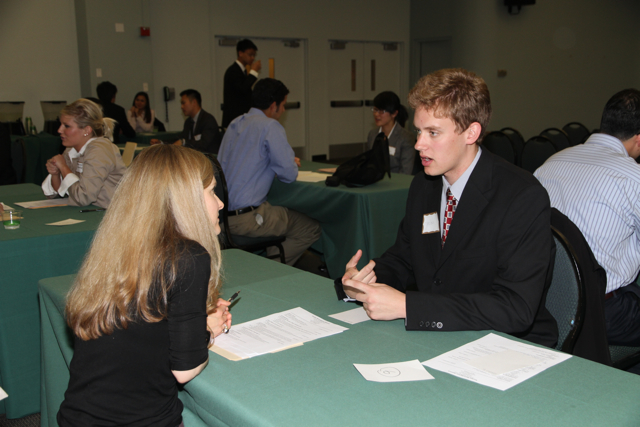 A strong interview is a two-way discussion: the employer evaluates your fit, while you evaluate the role and organization. Image: bpsusf, Wikimedia Commons, CC BY 2.0.
A job interview is not a memory test and it is not a performance in which the person with the smoothest personality automatically wins. It is a structured conversation in which an employer tries to reduce uncertainty. The interviewer wants evidence that you can do the work, learn what you do not yet know, communicate effectively, handle the situations the role creates, and work with the people around you. At the same time, you need enough information to decide whether the job is worth pursuing.
The U.S. Department of Labor describes the interview as a two-way discussion: the interviewer is assessing your knowledge, skills, and abilities, while you are assessing whether the organization and position fit your career goals. Its current interview guidance recommends researching the organization and position, reviewing your own application, preparing real examples, practicing typical questions, confirming logistics, listening carefully, answering directly, and asking questions before the conversation ends.
That creates a useful preparation principle: do not prepare by memorizing dozens of polished sentences. Prepare by building a small library of truthful evidence and learning how to retrieve the right example when a question appears.
1. Read the Job Description as an Interview Blueprint
Start with the job posting, not with a generic list of interview questions.
Print it, copy it into a document, or place it beside your notes. Highlight four types of information:
- Responsibilities: what the person will actually do.
- Required skills: tools, methods, communication abilities, technical knowledge, or domain experience.
- Results: outcomes the role is expected to produce.
- Signals of importance: duties mentioned repeatedly, placed near the top, or described with words such as “must,” “critical,” “primary,” or “responsible for.”
Turn each important requirement into an interview question. If the posting says “manage multiple client projects and competing deadlines,” write: “Tell me about a time I managed several priorities at once.” If it says “analyze weekly sales data,” write: “What example shows that I can turn data into a decision?”
Why this matters: interviewers often build questions around competencies named in the job announcement. Department of Labor guidance specifically advises reviewing the duties, requirements, evaluation methods, and competencies in the announcement because they can indicate what the interviewer may ask.
Common mistake: focusing only on qualifications you already have. Pay equal attention to areas where your experience is indirect. You need a truthful explanation of how your background transfers.
2. Build a Requirement-to-Evidence Map
Create a simple table with three columns:
| What the job needs | Your evidence | Result |
|---|---|---|
| Manage deadlines | Coordinated a product launch across design, sales, and operations | Launched two days early |
| Handle customers | Resolved recurring billing complaints | Reduced repeat complaints over the next quarter |
| Analyze data | Built a weekly spreadsheet dashboard | Found a high-return campaign and shifted budget |
| Learn software quickly | Self-taught a new CRM during team migration | Helped train three colleagues |
Your evidence does not have to come only from paid employment. Department of Labor guidance explicitly notes that relevant examples may come from paid and non-paid experience. Students can use coursework, group projects, internships, clubs, labs, volunteering, freelance work, or personal projects when those examples genuinely demonstrate the required skill.
The evidence map prevents two common interview problems: giving a generic answer because you cannot think of an example, and using your favorite story for every question even when it does not fit.
3. Build a Story Bank Before You Practice Questions
You do not need 30 stories. For many interviews, eight to twelve flexible examples cover most behavioral topics.
Try to include examples of:
- a difficult problem you solved;
- a time you handled conflict or disagreement;
- a mistake or failure and what changed afterward;
- a deadline you protected under pressure;
- a process you improved;
- a customer or stakeholder problem;
- a time you learned something quickly;
- a project you led or influenced without formal authority;
- a situation involving ambiguous instructions;
- a measurable success you are proud of.
For each story, record the situation, what was expected, what you personally did, what happened, and what you learned. The goal is not to memorize a speech. It is to remember the structure and key facts.
4. Use STAR Without Sounding Like a Template
The STAR framework—Situation, Task, Action, Result—is useful because it stops stories from wandering. But a rigid “Situation… Task… Action…” recitation can sound mechanical.
Instead, use STAR invisibly.
Situation: Give only enough context to understand the problem.
Task: Clarify what you were responsible for.
Action: Spend most of the answer here. Explain what you did, why, and how.
Result: Describe the outcome. Use numbers when they are accurate and relevant, but do not invent metrics just to sound impressive.
Example:
“Our support team was receiving a surge of duplicate billing tickets after a pricing change. I was responsible for finding the cause and reducing repeat contacts. I reviewed a sample of tickets, grouped them by issue, and found that customers were misunderstanding one sentence in the billing email. I worked with the product and support leads to rewrite that section and created a response macro for agents while the change was deployed. The duplicate-ticket volume dropped noticeably over the next two weeks, and the team kept the revised wording for future billing notices.”
That answer contains STAR without announcing it.
5. Keep Context Short and Action Specific
Candidates often spend 70% of a behavioral answer explaining the background and then rush through what they actually did.
Reverse that balance. Interviewers usually care most about your reasoning and behavior.
Instead of:
“We had a very complicated project with many departments, and there were several meetings and lots of stakeholders…”
Say:
“A launch deadline was at risk because design and compliance were working from different requirements. I compared both versions, created a single issue list, and scheduled a 20-minute decision meeting with the two owners…”
The second version exposes decision-making.
6. Make Your Role Clear When Describing Team Work
Use “we” for collective outcomes and “I” for your contribution.
Weak:
“We improved onboarding and reduced errors.”
Clearer:
“The team redesigned onboarding. My part was mapping the error points in the first-week process and testing the new checklist with three new hires. The team then adopted the checklist across the department.”
This gives appropriate credit without making you disappear inside the group.
7. Prepare a 30-to-60-Second Professional Introduction
Department of Labor guidance recommends being ready to summarize your experience in roughly 30 to 60 seconds.
A useful introduction has three parts:
- What you do or have been developing.
- The experience most relevant to this role.
- Why this opportunity makes sense now.
Example:
“I’m a customer-support specialist with four years of experience in SaaS environments, mainly handling billing and account issues. Over the last year I’ve taken on more process work, including building macros, reviewing ticket trends, and helping train new hires. I’m now looking for a customer-success role where I can use that support experience more proactively, which is why this position caught my attention.”
Do not use your entire life story. The answer should orient the interviewer and create useful follow-up paths.
8. Research the Organization Beyond the Homepage
Department of Labor and CareerOneStop both recommend researching the employer before the interview. Good research helps you answer “Why this company?” and improves the questions you ask.
Review:
- the organization’s official website;
- mission and stated values;
- products or services;
- customers or users;
- recent announcements;
- leadership pages;
- the specific department, when known;
- job openings similar to yours;
- public documentation, product pages, or annual reports when relevant.
Your goal is not to collect trivia. Look for connections between the organization’s current work and the role you are interviewing for.
9. Prepare a Specific Answer to “Why Do You Want This Job?”
A strong answer combines the work, the organization, and your direction.
Weak:
“I’ve always wanted to work for a great company like yours.”
Stronger:
“I’m interested because the role combines customer research with product operations. In my current work, the part I enjoy most is turning recurring customer problems into process changes. I noticed this team is expanding its self-service product, so the chance to work closer to product decisions is a logical next step for me.”
This shows you understand what the job actually is.
10. Prepare for “Tell Me About Yourself” Separately
“Tell me about yourself” is not identical to “Why do you want this job?”
Your answer should give a relevant professional narrative. One practical structure is Present–Past–Future:
- Present: your current role, focus, or stage.
- Past: one or two experiences that explain how you got here.
- Future: what you want next and why this position fits.
Keep personal history only if it genuinely helps explain the professional path.
11. Prepare for Strengths With Evidence
Do not answer “What is your greatest strength?” with an adjective alone.
Use:
Strength → evidence → relevance.
“One of my strengths is turning ambiguous requests into an organized plan. In my last project, three departments had different assumptions about a launch, so I documented the dependencies and owners in one tracker. That helped us identify two missing approvals before they became delays. I think that would be useful in this role because the job description emphasizes cross-functional coordination.”
12. Prepare for Weaknesses Without Using a Fake Strength
A useful weakness answer shows self-awareness and management.
Choose something real but not a core requirement you currently cannot perform.
Structure:
- what the limitation is;
- how you noticed it;
- what you are doing about it;
- what has improved.
Example:
“Earlier in my career I tended to wait too long before escalating blocked work because I wanted to solve everything myself. I realized that sometimes reduced the team’s options. I now set explicit escalation points on high-risk tasks and flag a blocker once it reaches the agreed threshold. That has made my project communication much more predictable.”
13. Prepare a Real Failure Story
Interviewers who ask about failure are usually looking for judgment, ownership, learning, and recovery.
A useful failure answer includes a meaningful consequence but does not require a catastrophic event.
Avoid blaming another person, claiming the failure was secretly a success, or choosing something so trivial that no learning was required.
Explain what you would do differently today.
14. Prepare for Conflict Questions With Professional Restraint
Conflict questions are not invitations to describe how difficult your former colleague was.
Focus on the disagreement, not the personality.
Explain how you clarified the underlying goal, listened, used evidence, found a decision process, or escalated appropriately.
Department of Labor guidance specifically advises remaining positive and avoiding negative comments about past employers.
15. Prepare for Questions About Gaps or Career Changes
Keep explanations factual, brief, and forward-looking.
For an employment gap:
“I took eight months away from full-time work to care for a family member. During that period I completed a bookkeeping course and kept up with Excel through volunteer work. I’m now available for full-time work and focused on roles where I can use both my administrative background and stronger reporting skills.”
For a career change:
“My background is in retail operations, but the part of the work I increasingly owned was data analysis and process improvement. I completed two analytics projects, learned SQL and Power BI, and I’m now targeting junior analyst roles where that part of my experience is central rather than occasional.”
Do not apologize for the existence of a transition. Explain the logic and evidence.
16. Practice Common Questions, But Do Not Memorize Full Scripts
CareerOneStop recommends practicing answers to common questions on paper and out loud, using real examples from work, education, or other experience.
Practice question families:
- Tell me about yourself.
- Why this role?
- Why this organization?
- What are your strengths?
- What is an area you are improving?
- Tell me about a conflict.
- Tell me about a failure.
- Tell me about a difficult customer.
- Tell me about a deadline.
- How do you prioritize?
- How do you learn something new?
- Why are you leaving your current role?
Memorize facts and structure, not sentences. Word-for-word memorization increases the chance that you will sound unnatural or become stuck if the interviewer phrases the question differently.
17. Practice Out Loud, Not Only in Your Head
Thinking through an answer is not the same as saying it.
Record yourself on a phone or computer. Listen for:
- answers that take too long to reach the point;
- repeated filler words;
- vague claims;
- missing results;
- overuse of “we” when your contribution is unclear;
- excessive detail that does not answer the question.
Do not aim to eliminate every pause. A thoughtful pause is better than filling space with words that weaken the answer.
18. Run at Least One Mock Interview
CareerOneStop notes that practice with a friend, an interview-practice resource, or an American Job Center mock interview can help candidates prepare.
Ask your practice interviewer not to rescue you immediately. They should let you finish an imperfect answer, then give feedback on:
- clarity;
- specificity;
- length;
- evidence;
- tone;
- whether the answer actually addressed the question.
 Mock interviews are useful because they reveal communication habits that silent preparation misses. Image: Germanna Community College, Wikimedia Commons, CC BY 2.0.
19. Prepare Questions That Help You Evaluate the Job
CareerOneStop recommends preparing questions for the interviewer rather than automatically saying you have none.
Good questions reveal expectations, decision-making, support, and performance:
- What would a strong first 90 days look like in this role?
- How is performance measured?
- What are the biggest challenges the person in this role will inherit?
- Which teams does this role work with most often?
- What usually distinguishes people who do well on this team?
- What major priorities are expected in the next six to twelve months?
- How are decisions made when priorities conflict?
- What does onboarding look like?
Tailor at least one question to something you learned during your research or during the interview itself.
20. Avoid Questions You Could Answer in Thirty Seconds on the Website
If the company prominently lists its products, office location, or basic mission, asking “What does your company do?” can signal weak preparation.
Use public information as the starting point:
“I saw that you recently expanded the small-business product. How does this team’s work change as that customer segment grows?”
That question demonstrates research and invites useful context.
21. Prepare for In-Person Logistics the Day Before
Department of Labor guidance recommends confirming time, location, point of contact, and other logistics, and planning to arrive early because security and access procedures may vary.
Check:
- exact address;
- building entrance;
- parking or transit;
- estimated travel time;
- security or reception instructions;
- interviewer or contact name;
- phone number if available;
- weather and transportation disruptions;
- what identification may be required.
CareerOneStop advises planning to arrive about 10–15 minutes early for an in-person interview. Arriving far too early can also create inconvenience, so wait nearby if necessary.
22. Prepare a Simple Interview Folder
Department of Labor guidance suggests bringing physical copies of your resume when possible, along with a pen, notepad, and interview logistics.
You may also include:
- portfolio samples if relevant and appropriate;
- a reference list, if requested;
- certifications requested by the employer;
- questions you want to ask;
- a short note with your evidence stories.
Do not spread papers across the desk during the interview. The folder is a backup, not a script.
23. Choose Interview Clothing Based on the Workplace
Department of Labor guidance advises having a professional outfit that fits well. “Professional” depends on industry, employer, and role.
Research the workplace norm and choose clothing slightly toward the polished side of that norm if uncertain. Prioritize:
- cleanliness;
- good fit;
- comfort while sitting;
- shoes you can walk in confidently;
- minimal distractions.
The goal is to remove clothing as a source of stress so you can focus on the conversation.
24. Prepare Virtual Interviews as a Technical Event
CareerOneStop and Department of Labor guidance both emphasize preparation for phone and video interviews. Test the environment before interview day.
Verify:
- the meeting link;
- the platform and login requirements;
- camera permission;
- microphone quality;
- speaker or headset;
- internet connection;
- power and battery;
- lighting;
- background;
- notifications;
- backup contact method.
CareerOneStop recommends being ready to sign on 10–15 minutes early for online interviews.
25. Position the Camera for Natural Conversation
Place the camera close to eye level. Frame your head and upper torso with some space around you. Avoid a bright window directly behind you, which can darken your face.
Look at the interviewer on the screen when listening. When making an important point, occasional eye contact with the camera can feel more direct, but staring into the lens continuously is unnecessary.
Do not sacrifice comprehension for artificial camera-eye contact.
26. Create a Backup Plan for Technical Failure
Before the interview, identify:
- the recruiter or interviewer contact;
- a phone number when available;
- an alternate device;
- a mobile hotspot if practical;
- a charger.
If the video call fails, send a concise message:
“I’m having trouble reconnecting to the meeting link. I’m continuing to try, and I’m also available by phone at the number on my application if that is easier.”
Do not spend ten silent minutes troubleshooting without informing the interviewer.
27. Use Notes Carefully in Virtual Interviews
One advantage of a virtual interview is that you can keep brief prompts nearby. One danger is reading.
Use keywords only:
- three strengths;
- story names;
- two metrics;
- questions to ask.
Do not place a full script beside the camera. Your eyes and voice will usually reveal that you are reading.
28. Listen to the Entire Question Before Answering
Department of Labor guidance emphasizes listening carefully and answering directly.
Pause for one or two seconds if necessary. If the question has multiple parts, you can structure the response:
“There are two parts to that. First, how I prioritized the work; second, how I communicated the change to the client.”
This shows control without rushing.
29. Ask for Clarification When the Question Is Ambiguous
Department of Labor guidance explicitly notes that candidates can ask an interviewer to restate a question when clarification is needed.
Useful phrases:
- “When you say stakeholder, are you thinking mainly about customers or internal teams?”
- “Would you like an example from my current role or from any past experience?”
- “Are you asking about how I prioritize day-to-day work, or how I handle competing project deadlines?”
Clarifying is better than confidently answering the wrong question.
30. Admit When You Do Not Know Something
If you are asked a technical or factual question you genuinely cannot answer, do not invent knowledge.
Use a professional bridge:
“I haven’t used that specific system. I’ve worked with two similar CRM platforms, and my approach would be to first understand the workflow and permissions, then test the common tasks in a sandbox or training environment. I would not want to pretend I know the exact interface.”
This protects credibility while showing learning behavior.
31. Think Aloud When the Interview Is Testing Reasoning
For case, technical, estimation, or problem-solving questions, interviewers may care about your process as much as the final answer.
State assumptions:
“I’d want to separate whether the drop came from fewer visitors, lower conversion, or a reporting issue. I would first validate the data source, then compare traffic and conversion by channel…”
This gives the interviewer material to evaluate and allows them to correct assumptions.
32. Use Numbers Only When You Can Defend Them
Specific results are persuasive, but fake precision is risky.
If you know the metric, use it.
If you remember only an approximate range, label it honestly:
“The reduction was roughly 20%, based on our weekly ticket dashboard.”
If no metric existed, describe observable outcomes instead of inventing one.
33. Prepare for Salary Questions Without Letting Them Dominate the Interview
Salary conversations vary by employer, location, and hiring stage. Department of Labor guidance for federal interviews notes that salary, benefits, and HR matters are often best addressed with the appropriate HR contact.
For general interviews, if salary expectations arise early, you can ask about the employer’s range:
“I’m most focused on fit and the responsibilities. Could you share the budgeted range for the role so I can make sure we’re aligned?”
If you provide a target, base it on credible market research, your experience, the role, and the local market. Avoid presenting a random number under pressure.
34. Prepare for Panel Interviews
Department of Labor guidance recommends asking whether there will be one interviewer or multiple interviewers.
In a panel:
- write down names and roles if necessary;
- begin your answer by acknowledging the person who asked;
- include the rest of the panel naturally with your gaze;
- do not assume the most senior title is the only important evaluator;
- track multi-part questions carefully.
If several people ask overlapping questions, vary your evidence rather than repeating the same story unchanged.
35. Treat the Interview as a Two-Way Evaluation
A candidate who is desperate to be chosen can forget to evaluate the opportunity.
Listen for evidence about:
- manager expectations;
- workload;
- decision authority;
- role clarity;
- onboarding;
- turnover;
- how feedback is given;
- how priorities change;
- what success actually means.
If three interviewers describe the role very differently, that is useful information.
36. Notice Red Flags Without Overreacting to One Imperfect Answer
Potential concerns include:
- no clear explanation of responsibilities;
- contradictory expectations;
- pressure to accept immediately;
- disrespectful comments about former employees;
- unexplained turnover;
- unclear compensation after direct questions;
- requests for sensitive financial information unrelated to legitimate hiring processes;
- requests to pay money to obtain the job.
One awkward interviewer does not prove the organization is bad. Look for patterns and verify concerns.
37. Close the Interview With Clarity
Department of Labor guidance recommends reinforcing your interest, thanking the interviewer, and asking about next steps and timeframes.
A simple close:
“Thank you. The conversation made me more interested in the role, especially the work you described around the new client onboarding process. Is there anything else about my background that would be useful to clarify before we finish? And what are the next steps in the process?”
This creates a chance to address an unresolved concern.
38. Send a Thank-You Message After the Interview
Department of Labor guidance recommends sending a thank-you email and using it to reinforce strengths or add context where useful.
Keep it short. Mention one specific point from the conversation and reaffirm interest.
Example:
“Thank you for speaking with me today about the operations coordinator role. I especially appreciated learning how the team is standardizing the client handoff process. That connects closely with the workflow project I described during our conversation. I remain very interested in the role and appreciate your time.”
Do not send a long sales letter after a 30-minute interview.
39. Correct a Small Interview Mistake Without Writing an Essay
If you forgot a relevant fact or gave an unclear answer, a thank-you note can add one concise clarification:
“One detail I did not explain clearly: the migration project I mentioned involved approximately 18,000 customer records, and my responsibility was the exception-review workflow rather than the database migration itself.”
That kind of correction can improve accuracy and credibility.
40. Follow Up Based on the Timeline You Were Given
Department of Labor guidance notes that hiring can take time and that candidates can follow up if they have not been contacted within the established timeframe.
If the interviewer says, “We will decide by Friday,” wait until the stated period has passed. Then send a short message asking whether there is an updated timeline.
Repeated daily follow-ups rarely improve the decision.
41. Tell References Before the Employer Contacts Them
Department of Labor guidance recommends notifying references in advance if they may be contacted.
Send each reference:
- the company;
- the role;
- the job description;
- the experience you hope they can speak about;
- the likely timing.
Do not script what they should say. Give context so they are not surprised.
42. Debrief Immediately After the Interview
Within an hour, write down:
- questions you were asked;
- answers that worked;
- answers that wandered;
- facts you learned about the role;
- names and roles of interviewers;
- promised follow-ups;
- concerns or red flags;
- new questions for the next round.
This turns every interview into training for the next one.
 Good preparation makes it easier to focus on the actual discussion instead of trying to remember rehearsed lines. Image: amtec_photos, Wikimedia Commons, CC BY-SA 2.0.
43. Prepare Differently for a First-Round Recruiter Screen
A recruiter screen often checks basic alignment before a deeper interview.
Be ready to explain:
- your current situation;
- why you applied;
- your relevant experience;
- location or work authorization if legitimately relevant;
- availability;
- compensation alignment when asked;
- major career transitions.
Keep answers concise. The recruiter may not be the expert on every technical detail.
44. Prepare Differently for a Hiring-Manager Interview
The hiring manager is more likely to test how you would function in the role.
Expect deeper questions about:
- priorities;
- problem solving;
- tradeoffs;
- collaboration;
- results;
- mistakes;
- domain knowledge;
- how you work under the manager’s constraints.
Use detailed examples and ask questions about expectations and team operation.
45. Prepare Differently for a Technical or Case Interview
For technical interviews, do not rely only on general behavioral preparation.
Review the core knowledge explicitly named in the posting. Practice representative tasks under realistic time constraints. If the company provides an interview guide, use it as the primary source for format.
During the interview, communicate assumptions and reasoning. A correct answer with no visible reasoning can be harder to evaluate than a structured attempt.
46. Prepare Differently for an Entry-Level Interview
If you have limited professional experience, do not apologize repeatedly.
Use evidence from:
- coursework;
- group projects;
- internships;
- student organizations;
- volunteering;
- part-time work;
- personal projects;
- family business responsibilities.
Translate the experience into the competency the employer needs.
“I have never managed a corporate project” is less useful than “In my final-year project I coordinated four students, divided research tasks, maintained deadlines, and combined the work into one presentation. That is not the same scale as this role, but it taught me how to make ownership visible and follow up when a dependency slipped.”
47. Prepare Differently for a Career-Change Interview
A career changer needs a bridge narrative.
Explain:
- what you did before;
- which parts transfer;
- what gap you identified;
- what you did to close it;
- why the new path is deliberate.
Do not rely on enthusiasm alone. Show evidence that the transition is already underway.
48. Prepare Differently for a Leadership Interview
Leadership interviews often test judgment beyond personal task execution.
Build stories about:
- setting direction;
- making decisions with incomplete information;
- developing others;
- handling underperformance appropriately;
- managing tradeoffs;
- influencing peers;
- allocating resources;
- communicating bad news;
- changing strategy when evidence changes.
Show the system you created, not just the crisis you personally fixed.
49. Worked Example: Preparing for a Customer Success Interview
Suppose the job posting emphasizes onboarding, retention, account reviews, and cross-functional work.
Your evidence map could include:
- Onboarding: trained new customers on a support portal.
- Retention: resolved an account issue that prevented cancellation.
- Account review: summarized usage trends for a manager.
- Cross-functional: worked with product to fix a recurring workflow issue.
You prepare four stories, research the product, understand the customer segment, and build questions such as:
“How does the team distinguish onboarding completion from a customer actually reaching first value?”
Your preparation is now tailored to the job rather than to the abstract idea of “doing well in interviews.”
50. Worked Example: Preparing After a Long Employment Gap
A candidate has been out of paid employment for two years while caring for a parent.
The preparation problem is not to hide the gap. It is to explain it once and redirect to current readiness.
The candidate prepares:
- a two-sentence factual gap explanation;
- recent skills refreshed through an online course;
- a volunteer scheduling project as recent evidence;
- examples from earlier employment that match the new role;
- a clear statement that full-time availability has resumed.
When asked about the gap, the answer is calm and brief, leaving time for stronger evidence.
51. Worked Example: Preparing for a Virtual Panel Interview
A candidate will meet three managers over video.
Two days before, the candidate:
- tests the meeting platform;
- updates the display name;
- tests audio with the exact headset;
- checks lighting at the interview time;
- closes notifications;
- prints the job description;
- creates one page of story keywords;
- researches each interviewer’s role on the official company site;
- prepares questions for the team and manager.
On interview day, the candidate joins early, keeps water nearby but off camera, and uses a paper notepad so typing does not distract from the conversation.
52. Worked Example: Recovering From a Weak First Answer
The interviewer asks, “Tell me about a time you influenced someone without authority.”
The candidate gives a vague answer about teamwork and realizes it lacks a specific example.
Instead of panicking, the candidate says:
“I’d like to give you a more concrete example than the one I just described. On a website launch, I did not manage the compliance team, but I needed their approval before release…”
Then the candidate provides a focused story.
An interview is a conversation. You can improve an answer while you are still in it.
53. Troubleshooting Common Interview Problems
“My answers are too long.”
Write the question at the top of a page and your answer below. Cross out every sentence that does not help answer the question. In behavioral answers, reduce background and expand the action you personally took.
“I cannot think of examples quickly.”
Use a story bank with short titles: “late vendor,” “angry customer,” “dashboard,” “training mistake,” “team conflict.” Practice choosing a story from a question category rather than inventing one in real time.
“I have no experience.”
Look beyond full-time jobs. Use education, volunteering, projects, family responsibilities, internships, and part-time work when they genuinely demonstrate the skill.
“I get nervous and speak too fast.”
Practice out loud with deliberate pauses. Keep water available. Before answering, inhale and allow one second of silence. Slow speech usually sounds more confident than rushed speech.
“I forget what the question was.”
For long questions, repeat the core: “So the main thing you’d like me to address is how I prioritized the competing deadlines?”
“I do not know how formal to dress.”
Research the workplace and choose a clean, well-fitting option slightly toward the professional side of the normal environment.
“The interviewer seems cold.”
Do not assume that means the interview is going badly. Some interviewers follow a structured format and intentionally limit reactions. Focus on answering clearly.
“I was asked something I did not understand.”
Ask for clarification. It is better to clarify than to answer a different question.
“I was asked a question I cannot answer.”
State what you know, what you do not know, and how you would approach finding the answer. Do not bluff.
“The video platform failed.”
Contact the interviewer immediately using the backup channel, explain the technical issue briefly, and propose phone or alternate-link continuation.
54. A Seven-Day Interview Preparation Plan
Seven days before
Read the posting deeply. Build the requirement-to-evidence map. Research the company.
Six days before
Create eight to twelve story-bank examples. Identify missing evidence.
Five days before
Practice Tell Me About Yourself, Why This Role, strengths, weakness, conflict, failure, and priority questions.
Four days before
Research recent official company information and prepare questions.
Three days before
Run a mock interview. Record weak answers and rewrite only the structure.
Two days before
Confirm logistics, interviewers, platform, clothing, travel, documents, and accommodations.
One day before
Do a short final practice. Stop trying to learn everything. Sleep normally and prepare your materials.
Interview day
Review story keywords, arrive or sign in early, silence notifications, listen carefully, and treat the interview as a two-way discussion.
55. A 30-Minute Emergency Preparation Plan
If an interview is scheduled with little notice:
Minutes 0–5: Read the job description and highlight the five most important requirements.
Minutes 5–10: Match one real example to each requirement.
Minutes 10–15: Research the company’s official website, product, and current priorities.
Minutes 15–20: Practice Tell Me About Yourself, Why This Role, one success, one failure, and one conflict example.
Minutes 20–25: Prepare three questions for the interviewer.
Minutes 25–30: Check logistics or video equipment.
This is not ideal, but it is far better than spending all 30 minutes reading generic interview advice.
56. Final Interview Checklist
- I know the five to eight most important requirements in the job description.
- I have real evidence for each major requirement.
- I can explain my professional background in 30–60 seconds.
- I have prepared behavioral examples for conflict, failure, prioritization, learning, and success.
- I researched the organization using official sources.
- I can explain why this role makes sense for me.
- I prepared thoughtful questions.
- I confirmed time, location, platform, and point of contact.
- I know whether the interview is individual or panel-based when that information is available.
- I tested video, microphone, internet, and backup options for a virtual interview.
- I have the documents the employer requested.
- I know how I will travel or sign in early.
- I can explain gaps or transitions briefly and honestly.
- I will not invent experience, metrics, or technical knowledge.
- I will ask for clarification if a question is unclear.
- I will ask about next steps before leaving.
- I will send a concise thank-you message afterward.
- I will notify references if the employer plans to contact them.
- I will debrief the interview while the details are fresh.
Frequently Asked Questions
How many hours should I spend preparing for a job interview?
There is no universal number. Preparation quality matters more than duration. For a typical professional interview, you should at minimum understand the job, research the employer, build evidence stories, practice common questions out loud, prepare questions, and confirm logistics. A complex technical or case interview may require substantially more role-specific practice.
Should I memorize answers?
Memorize the facts, examples, and structure—not every sentence. Full scripts can make you sound rigid and make it harder to adapt when the interviewer asks a slightly different question.
What if I do not know an answer?
Be truthful. Explain what you know, identify the part you do not know, and describe how you would investigate or learn it. Bluffing can damage credibility more than an honest knowledge gap.
How early should I arrive?
CareerOneStop advises planning to arrive or sign in roughly 10–15 minutes early. Account for building security, transit, parking, and technical setup. If you arrive excessively early, wait nearby rather than creating pressure on the interviewer.
Is it okay to take notes during an interview?
Yes, in moderation. Department of Labor guidance notes that limited note-taking may be appropriate. Do not let writing prevent eye contact or listening. Record key details, decisions, names, and follow-up items rather than transcribing the conversation.
What should I ask at the end?
Ask questions that help you understand expectations, challenges, performance measures, team operation, onboarding, priorities, and next steps. Avoid asking only questions that are easily answered on the company website.
Should I send a thank-you email?
Department of Labor guidance recommends it. Keep the message concise, reference one specific part of the conversation, reinforce your interest, and add clarification only when genuinely useful.
How do I prepare for a video interview?
Test the exact platform, camera, microphone, internet connection, lighting, background, power supply, and notifications. Keep a backup contact method and sign in early. CareerOneStop specifically recommends preparing the space and equipment in advance.
What if the interviewer asks a question I think is unfair or inappropriate?
You do not have to answer every question exactly as framed. You can redirect to job-related information, ask how the question relates to the position, or decline politely. Employment-law rules vary by location, so seek reliable local guidance if you believe discrimination or unlawful hiring practices occurred.
What is the single most useful interview preparation exercise?
Build a requirement-to-evidence map from the actual job description. It forces you to connect what the employer needs with concrete proof from your own experience, which is the foundation of strong answers.
Conclusion: Prepare Evidence, Not a Performance
The strongest interview preparation is not a collection of clever phrases. It is a system for understanding the employer’s needs and retrieving accurate evidence from your own experience.
Start with the job description. Identify the important competencies. Build a small story bank. Practice speaking the stories aloud. Research the organization. Prepare questions that help you evaluate the opportunity. Remove logistical and technical surprises. Then, during the interview, listen carefully enough to answer the question that was actually asked.
The biggest mistake to avoid is trying to sound perfect. Perfect answers are not the goal; credible evidence, clear thinking, and professional communication are. If you only have time for one preparation step, take the five most important requirements in the posting and write one truthful example beside each. That gives you useful material for almost every part of the interview.
Sources and Further Reading
- U.S. Department of Labor — Interview Tips
- CareerOneStop — Get Ready to Interview
- CareerOneStop — Virtual Interviews
- CareerOneStop — Common Interview Questions
- USAGov — Job Training and Career Resources
Image Credits
- “Job interview 0001.jpg” — bpsusf, Wikimedia Commons, CC BY 2.0.
- “20150311 GCC Student Success Day (16795474912).jpg” — Germanna Community College, Wikimedia Commons, CC BY 2.0.
- “Woman on a Job Interview – 38141080114.jpg” — amtec_photos, Wikimedia Commons, CC BY-SA 2.0.